Volunteering in the Orosi Valley
The LEDs shine when I press the button on the coffeemaker, and soon hot water hisses inside. We brought these grounds back with us from Costa Rica and although the coffee will be good I miss the way we made it there. I miss the rattle of the kettle when the water boiled, the gurgle of the coffee as I pushed the plunger on the press, the cacophony of the jungle birds outside the window.
Yesterday we got back from a week in Costa Rica with Globe Aware, which offers weeklong service trips all over the world. Anne and I hoped to show our children – Farrah, age 8, and Jim, age 6 – a part of the world and a way of life that they’d never seen. We wanted them to see that not everyone has the privilege of living as we do and we wanted them to work in the service of others.
This is my journal.
May 25, 2026
Costa Rica presents a new climate, new allergens, and new bugs, so it had occurred to me that some of my family might get sick after we arrived. But I didn’t think to worry that we’d be getting sick as we arrived. Yet that seems to be happening.
Farrah has been sneezing for a couple days, and on the way to the airport and during the four-hour flight to San Jose, Anne started sniffling too. She says Jim may be getting sick as well. This is about the first time in my life that I can recall others around my having nasal congestion, to which I am prone, while I was unaffected. After landing in San Jose we meet our coordinator with Globe Aware, Federico, in the lobby of a hotel near the airport. He will drive us to the house where we’d be staying in Orosi Valley. During the drive we learn that Federico lives in the house where we volunteers will stay. I’m sure he’s not thrilled to be sharing a van and a house with a family growing ill.
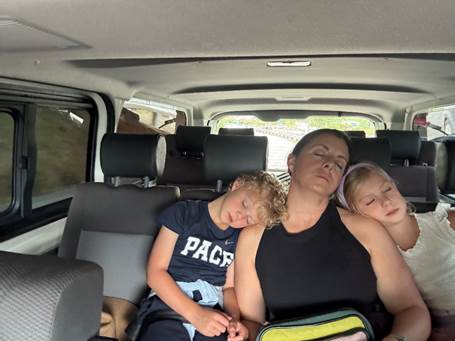
The drive today will be almost two hours. We drive through urban areas – San Jose, Cartago, Paraiso. Traffic is stop-and-go because there is a soccer game in San Jose. The scenery is not charming, at least to my eyes. Urban sprawl, beeping horns, gaudy signs. Almost all of the houses have high metal fences and gates. We pass fans in bright jerseys shouting at each other. The kids fall asleep, then Anne. Federico is trying to keep me entertained by telling me about the area, but I am tired and the warm sun is streaming through my window. When the van falls silent I slouch back and pull my hat over my eyes.
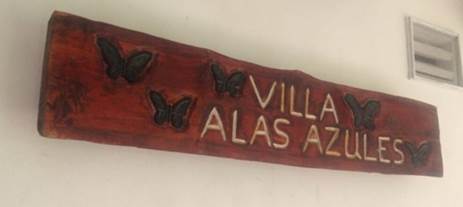
When I wake up the kids are talking and the scenery has taken a rural turn. Small fields, one after another, next to simple houses. The land is green. Mountains in the distance, some of which Federico says are volcanoes. The roads get smaller as we near our house, which is apparently big enough to have a name on Google Maps, the Villa Alas Azules.
When we enter the Orosi Valley the land is devoted to agriculture. Federico tells us that although farmers grow a variety of crops in the valley, the dominant product is chayote, a green gourd that resembles squash and is used throughout Central America. Federico downshifts as we turn out of the valley and climb into the hills. As we go higher the chayote vines give way to coffee trees. We pass through small communities that we will come to know better – Acevedo, Piedra Azul, El Yas. The houses are small but adequate, all built differently but about the same size. The high fences that were common in the city are mostly absent here. As we leave El Yas the road narrows, such that two large vehicles can’t pass in opposite directions. We keep climbing.
We stop in front of a blue gate with a padlock. Federico opens it and we bump down a lightly-graveled driveway then park under a weathered basketball goal beside the house. Kids and parents are happy to get out of the van.
The house is big enough for all of us, but the housekeeping has not been meticulous. A cardboard box that once contained outdoor lights sits on the porch, there is a gas can in the foyer, tools lie on tabletops, unwashed dishes sit by the sink. It isn’t filthy but the house is a long way from some of the hotels where my family has stayed on vacations in recent years. It looks like a house where a man usually lives alone.
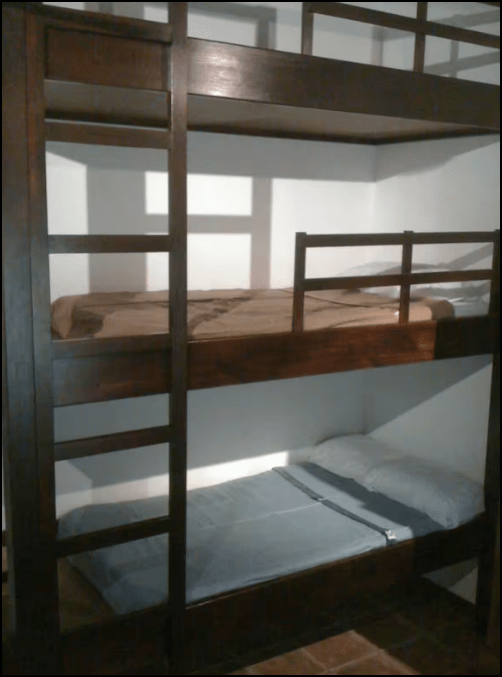
We move our children and bags into the two rooms where our family will stay, each of which has multiple bunkbeds. The beds are made and clean but the mattresses are thin and there are no decorative pillows. The sleeping quarters look like a bunkhouse at summer camp. None of this bothers me but I wonder what Anne thinks.
I catch her eye as she unpacks onto a set of shelves at the foot of a bunkbed. Anne smiles. That may be a pretense intended to reassure me, but she’s going to give it a chance.
May 26, 2025
Optimism filters through the window shades with the morning sun. Anne and I had gone to bed early, which was a good thing since several rainforest birds began conversing loudly outside our window at dawn, and letting the tourists sleep was not on their agenda.
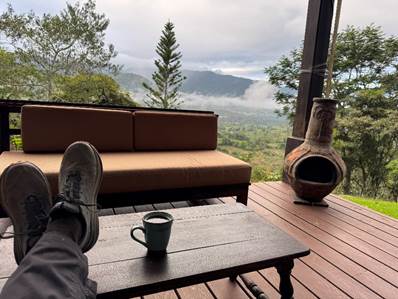
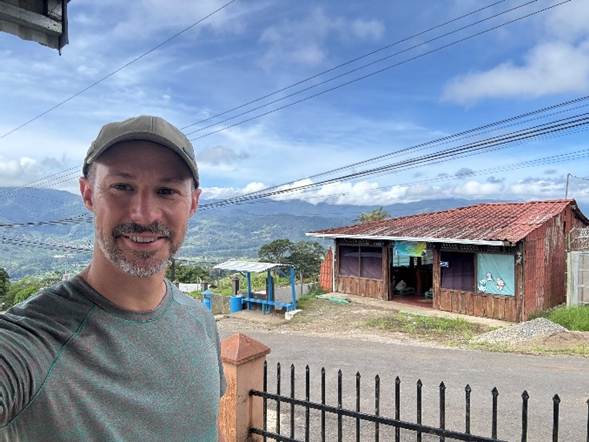
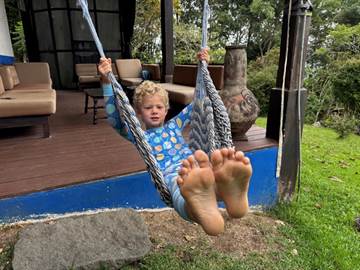
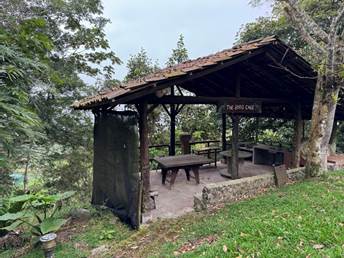
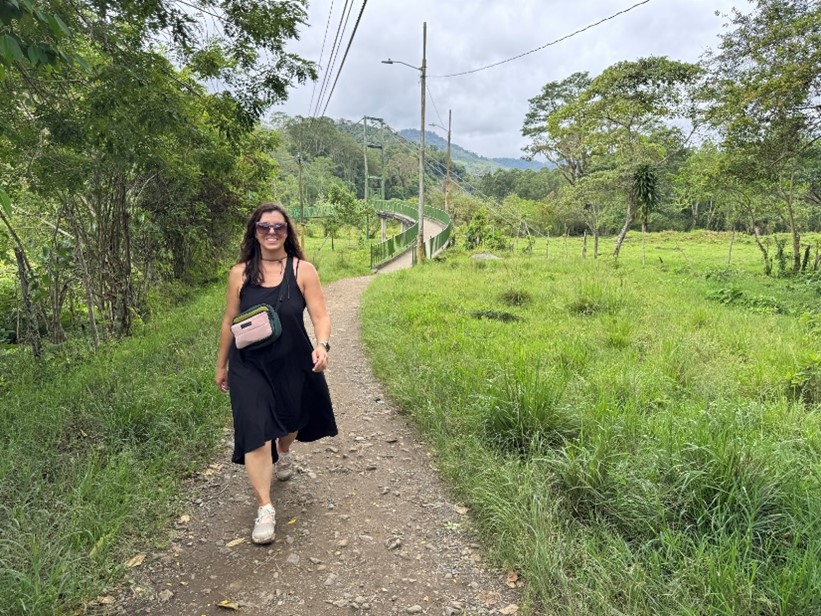
We drink coffee on the porch. Anne feels better. I prop my feet up and feel a soft breeze across my legs. The birds are many and beautiful with splashes of red, yellow, and green. Four toucans flit from tree to tree. The view from this porch is wonderful and in the days to come, we will spend most of our free time here. We sip Costa Rican coffee and gaze across the small farms of the Orsosi Valley. Through wispy clouds we can see to the deep green ridge beyond the valley and the town of Cachi, nestled where the valley floor meets the distant mountainside.
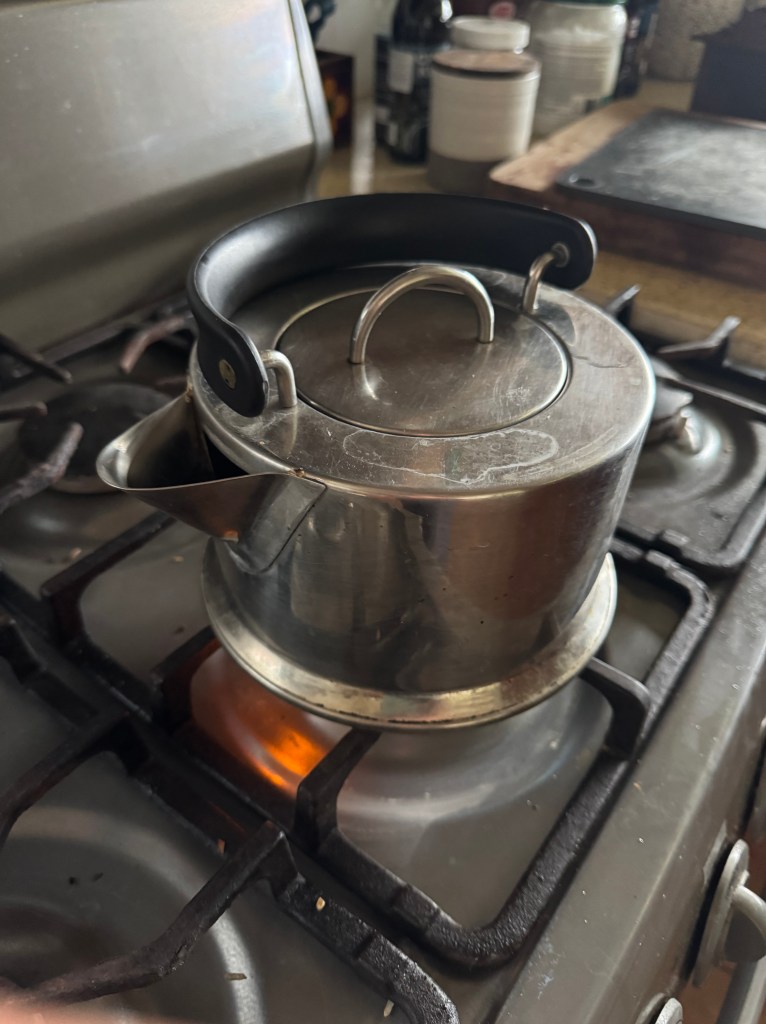
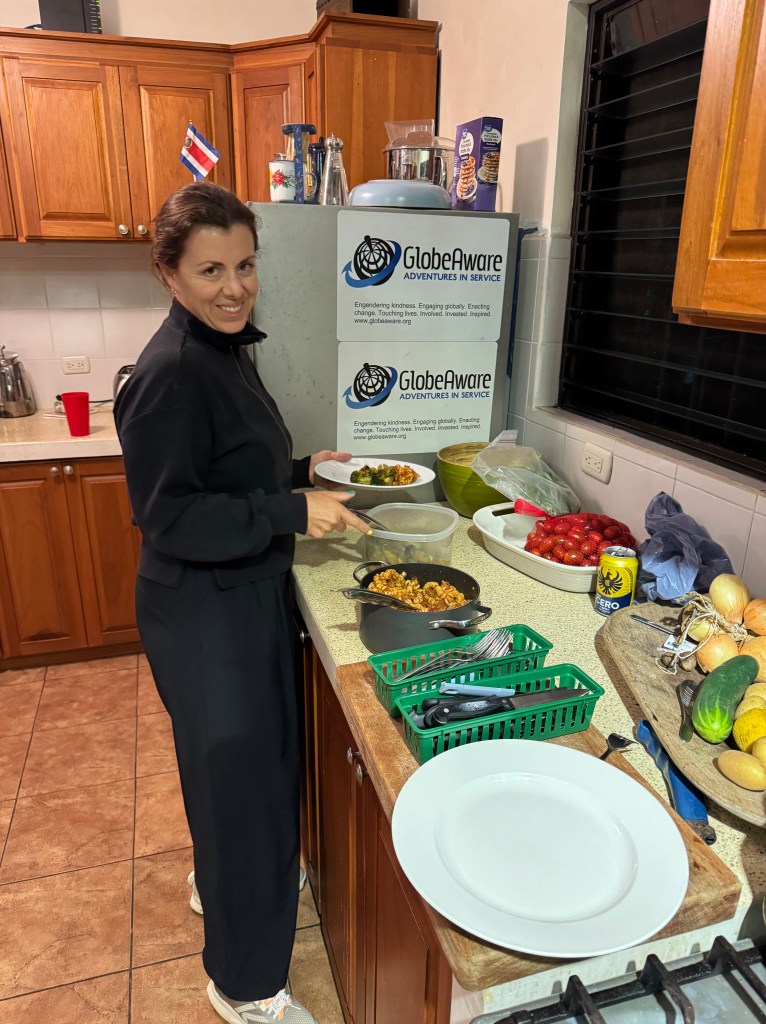
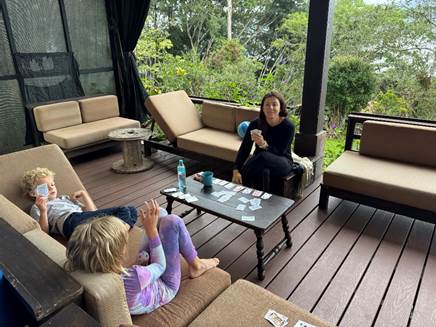
After the kids get up I cook breakfast while Anne plays cards with them on the porch. This will be a slow morning. We won’t start our volunteer work today but will instead leave around 9:30am to tour the area with Federico. I start the gas range with a Bic lighter and put water on to boil. We have time to be particular, so I’ll make boiled eggs for Jim, over-easy for Farrah, and scrambled for Anne and me. Federico is vegan, and instead of butter he uses a green mixture of coconut oil and herbs that he keeps in the refrigerator. He said we could use it, and Anne asks me to scramble our eggs in it instead of butter or oil. Federico’s mixture sizzles in the cast-iron skillet and the edges of each bright green glob have just started to brown when I crack eggs over them.
We tour the area in the big white Globe Aware van. Our first stop is the school in El Yas, a tiny community just up the mountain from our house. We have brought dry-erase markers, pencils, and other school supplies and Anne gives them to the headmaster. The schoolchildren are gathered for a boisterous outdoor award ceremony in which young teachers speak excitedly into microphones. We watch for a few minutes then tour the school grounds, which does not take long. We see a few classrooms, a schoolyard with two guava trees and an impressive view of the valley, and of course the nearby soccer pitch.
Schools are everywhere in Costa Rica, even in this rural mountainous area. Federico says that when the national government disbanded the military in 1949, it invested heavily in schools. It shows. He jokes that every Costa Rican community needs only four things – a school, a soccer pitch, a church, and a bar. Our experience over the coming week will corroborate his observation.
The ceremony at the school is noisy and Federico is happy to leave. “Most Latins like loud sounds but I am not one of them,” he says.
Federico grew up in San Jose, the country’s capital and largest city, but later in life he moved to the rural Orosi Valley. He speaks perfect English, which may be common in the city but is rare where we are. Most of the people we encounter outside of the tourist industry will speak no English. Federico is small in stature with short hair and glasses. I’m not sure how old he is. He once told our children that he was thirty-five and another time that he was fifty-five, and I can’t tell which is more plausible. He cuts the sleeves of his tee shirts so that they are about half as long and curl up at the edges.
Federico has been working with Globe Aware for twenty years. He is good with kids. He speaks fondly of his nieces and nephews but he has no children of his own. He never speaks of any spouse or long-term partner. Federico knows many people in the nearby communities but he is not of them. Once Federico was preparing us to meet some locals and he warned us that they would be shy. “These people talk to plants,” he said.
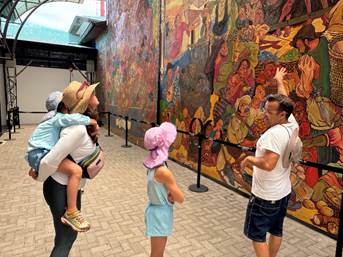
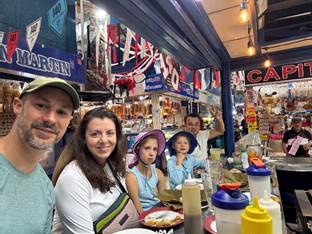
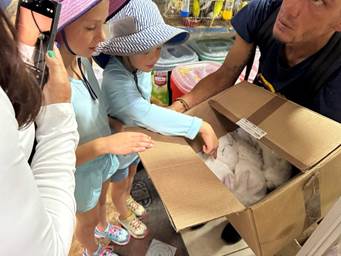
The tour continues, and Federico knows where to take us. We walk among ancient trees and the ruins of an old church in Ujarras. We tour a coffee farm that an American couple bought in the 1970s. We tour a bustling market in Cartago where merchants in tiny shops sell vegetables, meat, fish, turtle eggs, shoes, cell phone accessories, and live rabbits. At a counter in the market we stop for a lunch of beans and rice, chicken, stewed beef, tamales, guava juice, and tamarind juice. We visit a Catholic basilica and a museum with a mural about Costa Rica’s history. We buy groceries at Walmart. In the town of Orosi, where the American expats live, we stop at a coffee shop next to a church that has been in operation since 1746. While we wait for our coffee the kids and I play tag in the soccer pitch across the street.
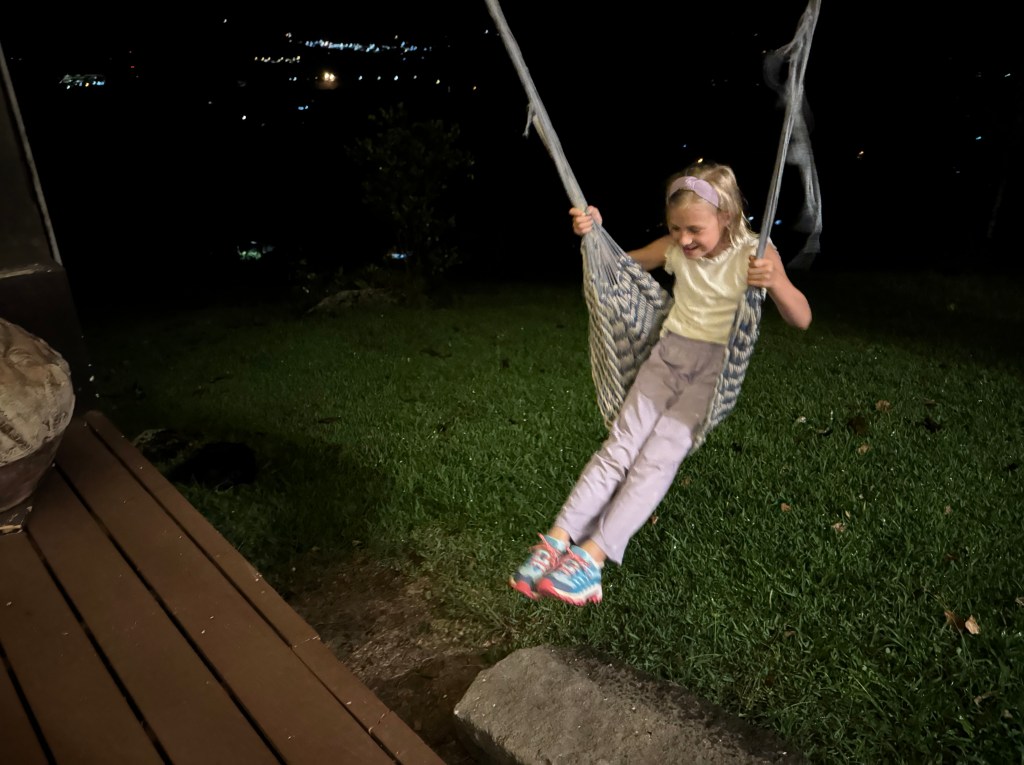
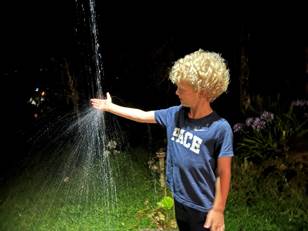
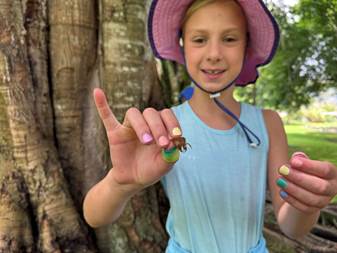
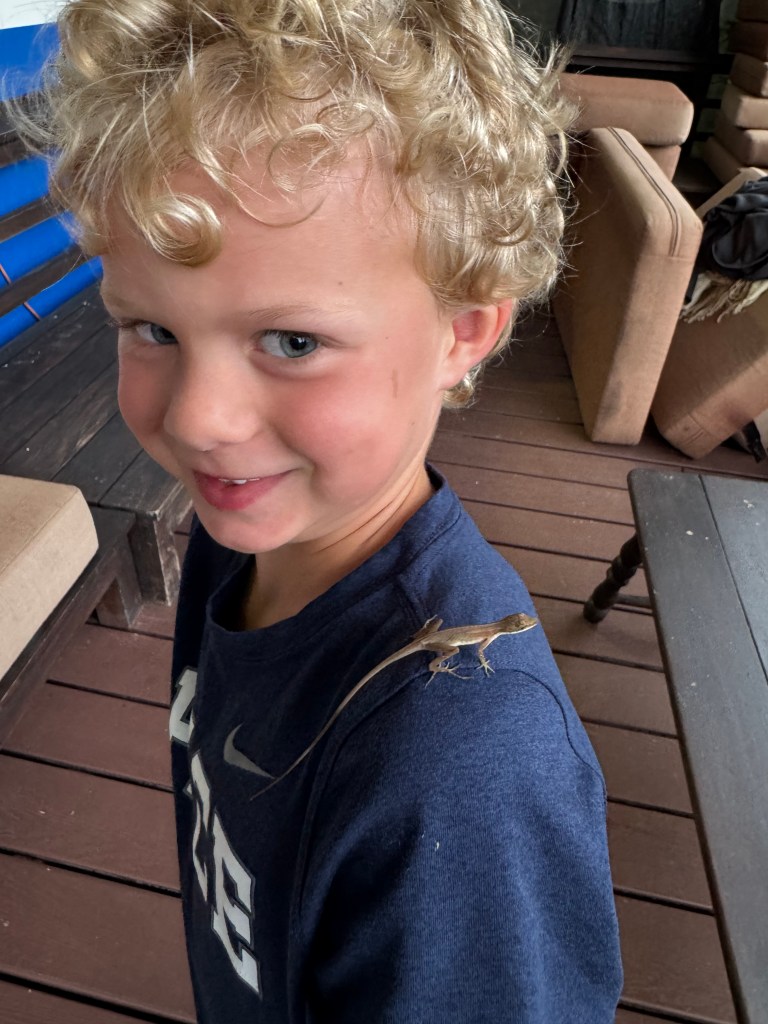
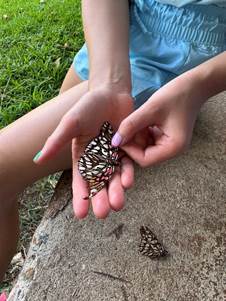
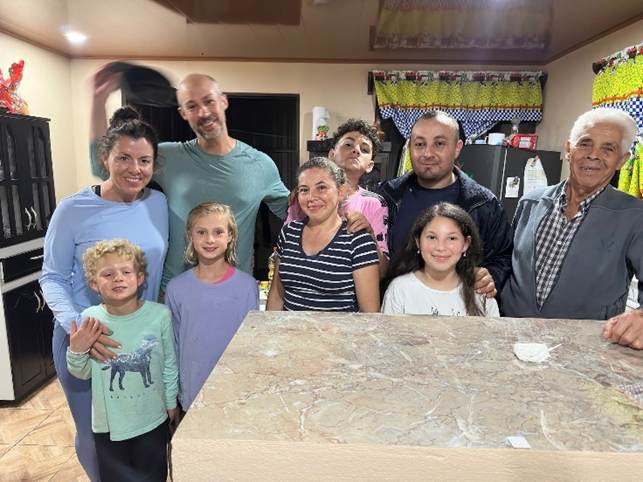
After a break at the house when the children chase bugs and take showers, we head up the mountain for dinner. We will be dining with a local couple that Federico calls “Grandma and Grandpa.” We will learn over the coming week that they are at the core of Globe Aware’s volunteer operation here. In the days to come we will meet, work alongside, and eat with Grandma and Grandpa, their grown children, their children-in-law, and their grandchildren.
They live in a community called La Flor. As the van climbs the mountain Federico tells us how the community got its name. There is a bus stop in El Yas, the community just down the mountain, where workers would gather as they traveled to and from farms in the bottom of the valley. For years there was a woman who lived up the mountain but would walk down to the bus stop in the morning and evening to sell flowers. Not everyone knew her name but everyone knew that she sold flowers and where she came from. As time passed people began to refer to the area where she lived by reference to her – “I live up by the flower,” they might say. “La flor” is Spanish for “the flower.” Now “Flor” appears for the area in Google Maps, which I guess makes it official.
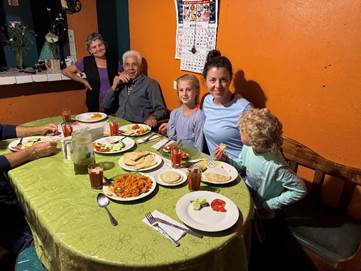
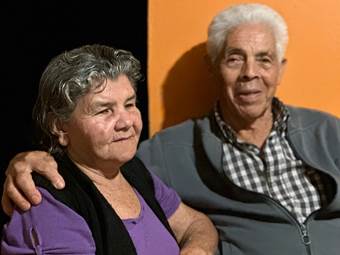
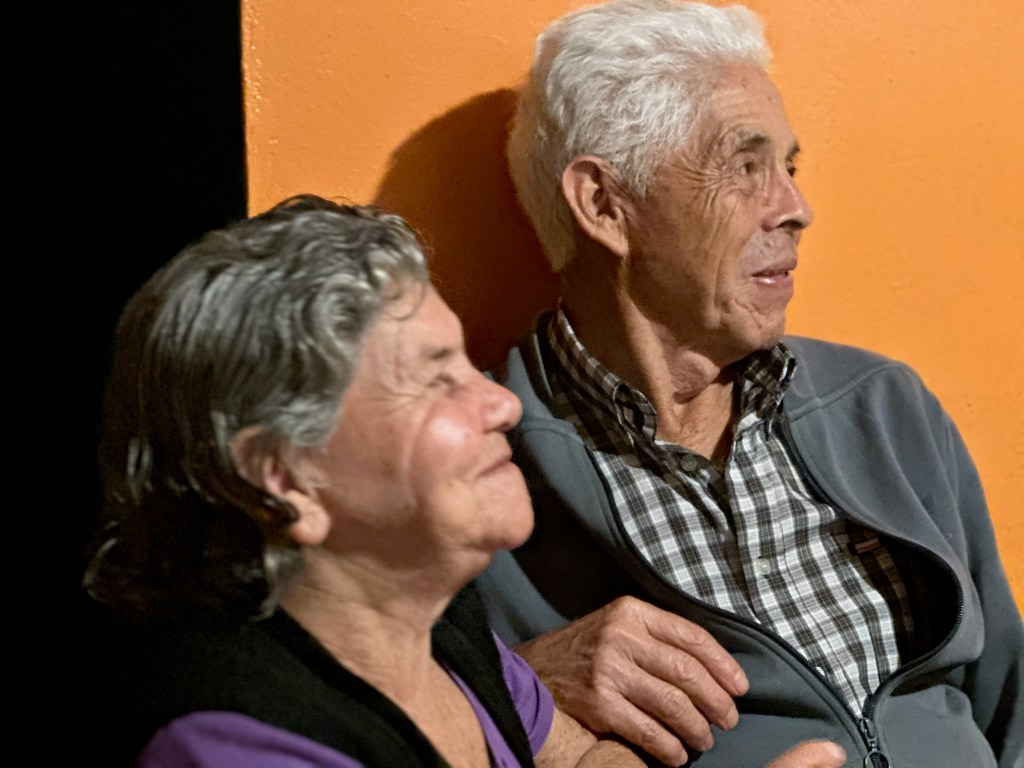
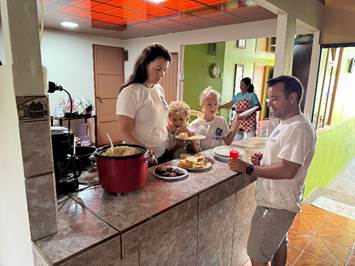
We park outside Grandma and Grandpa’s home. They live across from the school and next to the soccer pitch. On the porch are shelves of vegetables. Grandpa – whose real name is Paco – meets us at the door. He is tall and smiling with white hair and a direct gaze. We walk through a seating area with a large Bible open on a small table and pass into the kitchen where we will eat. The walls are dark orange and the tablecloth is light green. We meet Granma – whose real name is Luz – who leaves the stove to greet us with handshakes, kisses on cheeks, and Spanish words. She radiates hospitality and it is impossible not to believe that she is happy to have us here.
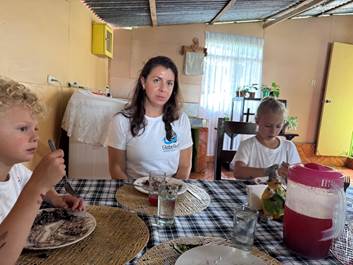
We sit down to rice and beans, vegetable soup, and patties made of beef, corn meal, onions, and bell peppers. Many of the vegetables come from Paco’s farm. I muster what remains of the Spanish I learned in high school and college and manage to say that the rice and beans are good. We are in the heart of a convivial family’s home and you can feel it. The children sense that it is time to be respectful. They mind their manners. When Jim overcomes his shyness I whisper a few words in his ear. He turns to Paco and Luz and says, “mi favorita es la sopa.” Luz beams. I would not trade this meal for a thousand fancy resort dinners.
With Federico translating we learn about our hosts. When Paco and Luz were young there was no road between the community now known as La Flor and the bottom of the valley, only a footpath. Paco lived in the hills and Luz on the valley floor. Paco’s father ran the only store in his community, which was also the family’s home. In the front wall was a shop window that could be opened for commerce or closed for privacy. It was usually open. On the inside of the wall were salable goods stacked against the wall, the family’s kitchen, the family’s dining table, and – eventually – the first television in the community. Paco said that on many nights while his family ate dinner with the TV on, twenty or so faces would peer in through the shop window to watch TV with them.
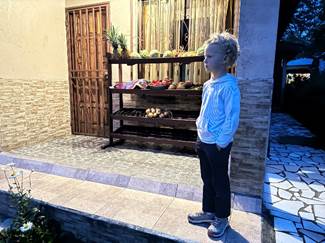
Eventually our children’s eyes are heavy and it is time to go. Anne is reluctant to leave. She is charmed, especially by Luz. We carry dishes to the sink, express our thanks as best we’re able, and walk out the front door into the warm night. Our hosts walk us out. Paco, now eighty-two, is still farming. The vegetables on his front porch came from his farm and they are on the shelves for sale. He has no fence or gate outside his home, just a cloth over the tomatoes to keep the birds away.
May 27, 2025
Today we will begin our service work – building benches in a community center in La Flor. But first, breakfast.
Anne and I drink Costa Rican coffee on the porch before Farrah and Jim wake up, then I cook while she plays cards with them. Hard-boiled eggs for Jim and over-easy for Farrah. For Anne and me, fresh chopped onions and cherry tomatoes mixed with eggs scrambled in Federico’s green mixture. I find potatoes next to the onions, so I slice one into circular chips and place them in another cast-iron skillet with olive oil. I pour peppercorns into an ancient grinder, crank the handle, then slide open the wooden drawer underneath. I sprinkle the ground pepper over the sizzling chips. In addition to the eggs and potatoes, we’ll eat local mangos, properly sliced by Federico.
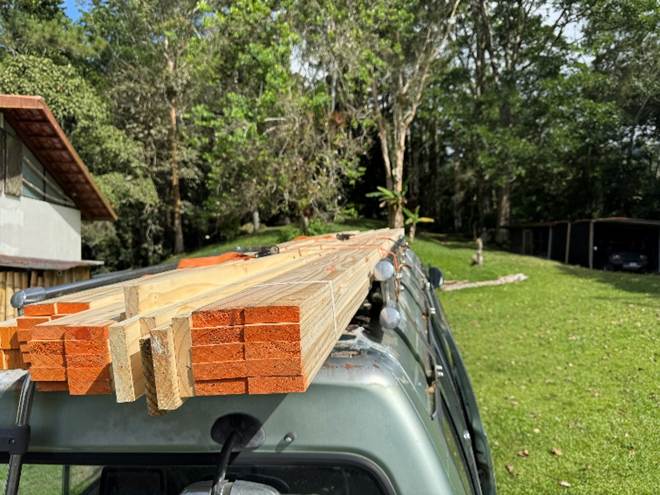
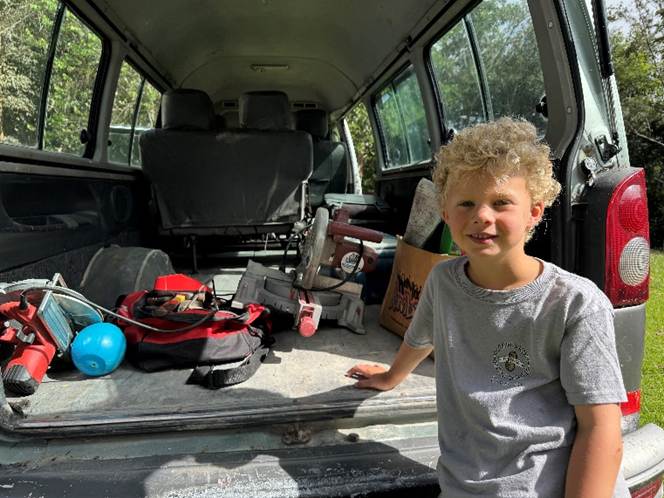
Federico is now loading the van – not the big white one we’ve been using, but an old green Hyundai with a better roof rack. Lumber goes on the roof. Tools and gloves in the back. Jim follows Federico around, insisting on helping with each step toward our departure. I intended to help, but a text from my law partner tells me that we’ve won an important case in the Court of Appeals, so I am happily distracted with the law for a few minutes.
At 8:30 we are in the van and headed up the mountain. Everyone seems fine – no illnesses after all. We stop at the community center, just a few doors away from Paco and Luz’s house.
Inside we meet Gustavo, who will show us what to do and how to do it. He is tall, in his fifties, with curly salt-and-pepper hair and glasses. He exudes calmness. “Gustavo has been working with volunteers for twenty-five years,” says Federico. “He has patience.”
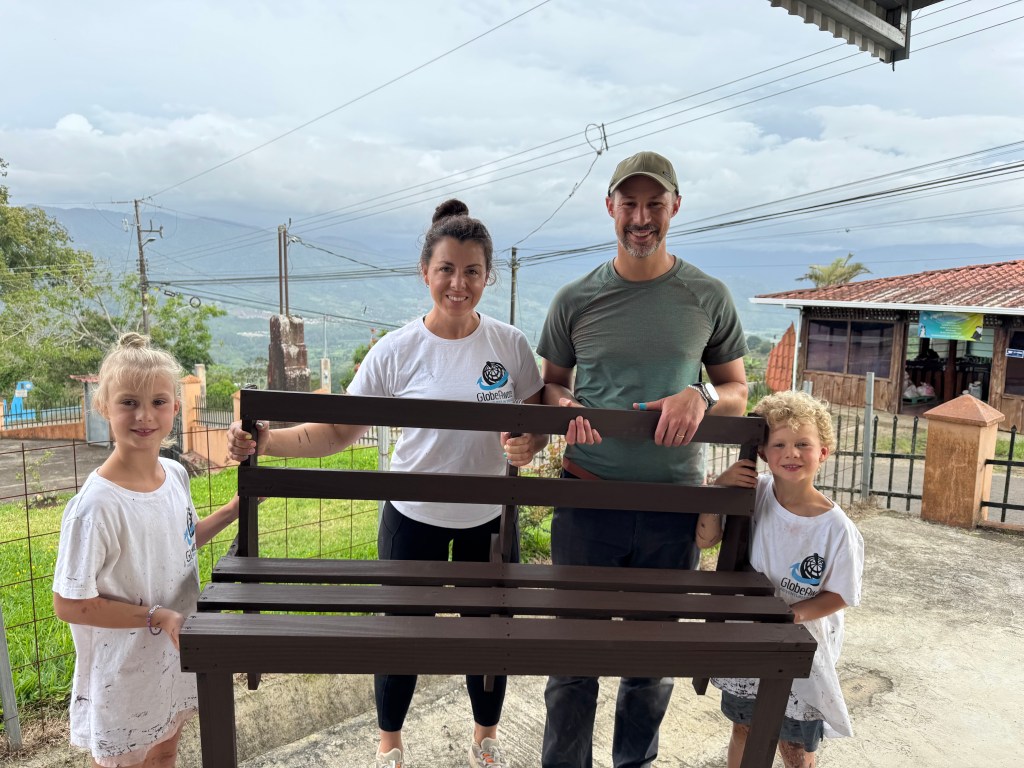
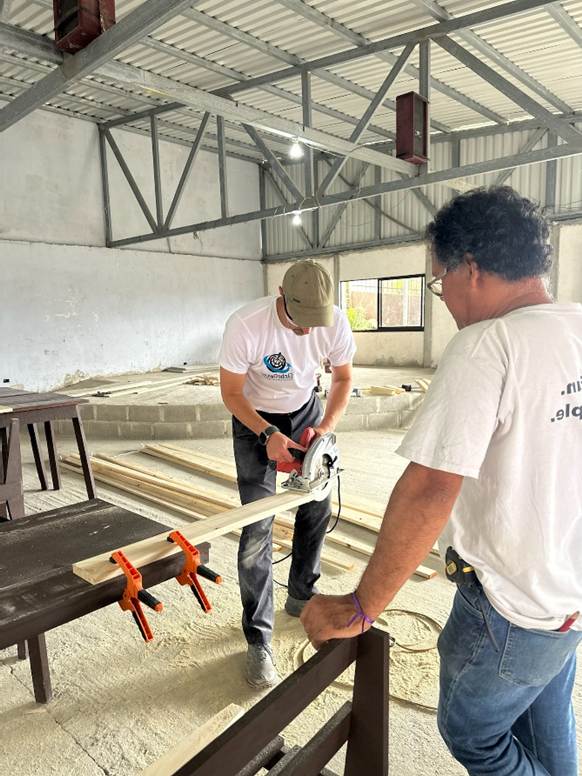
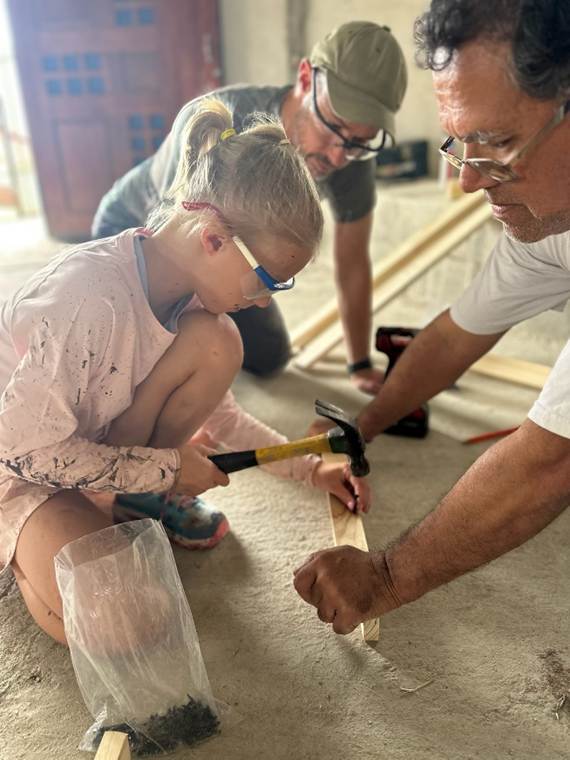
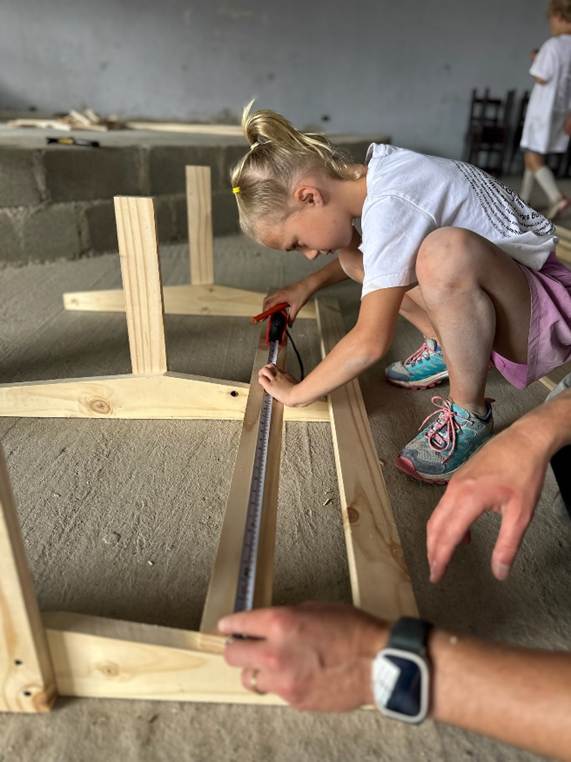
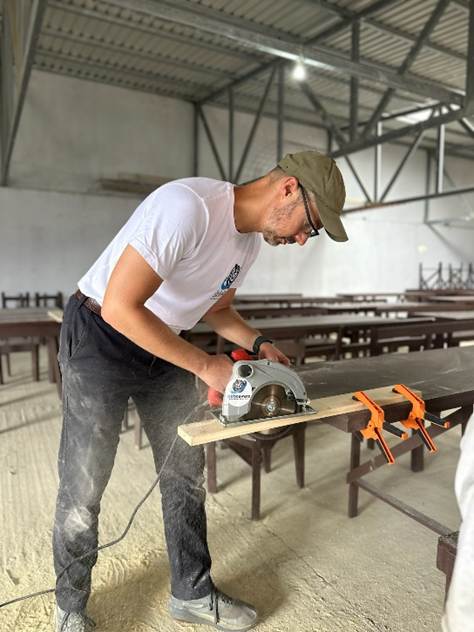
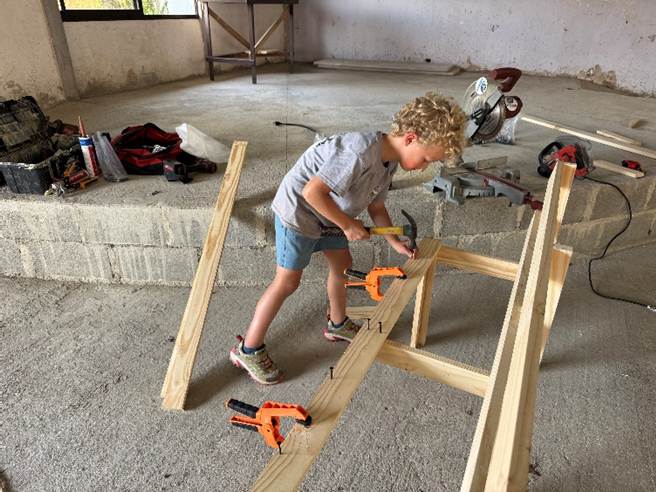
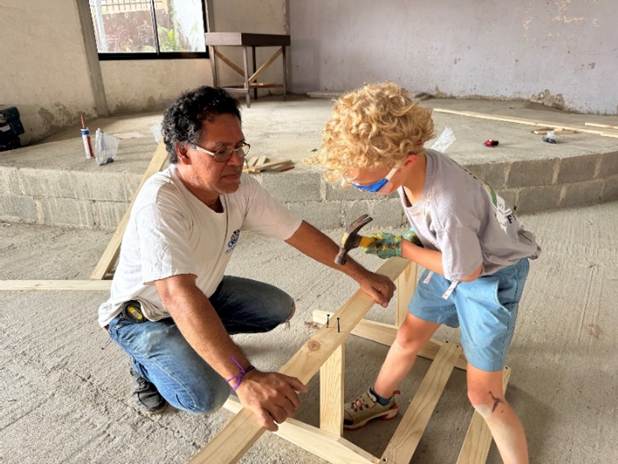
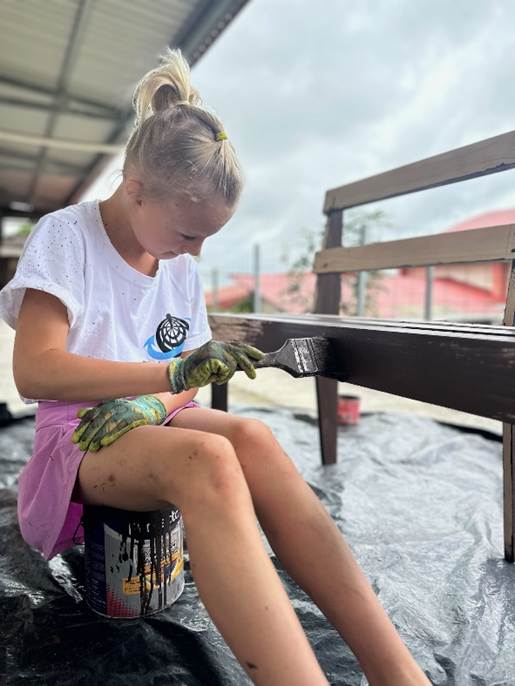
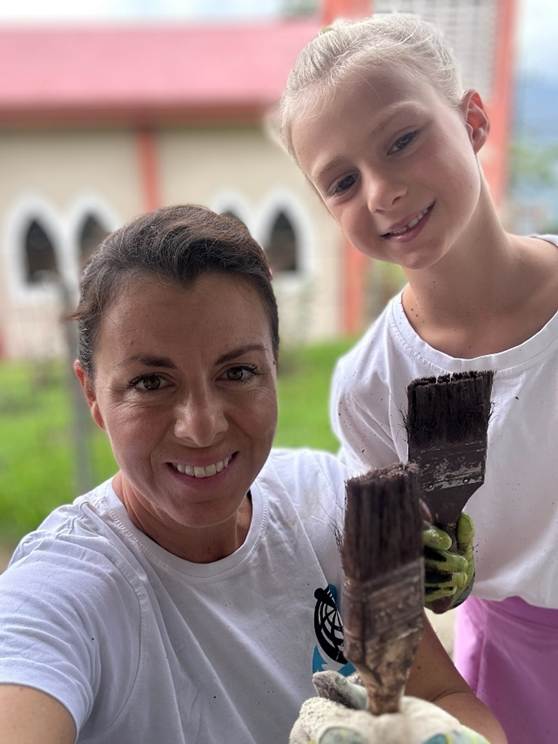
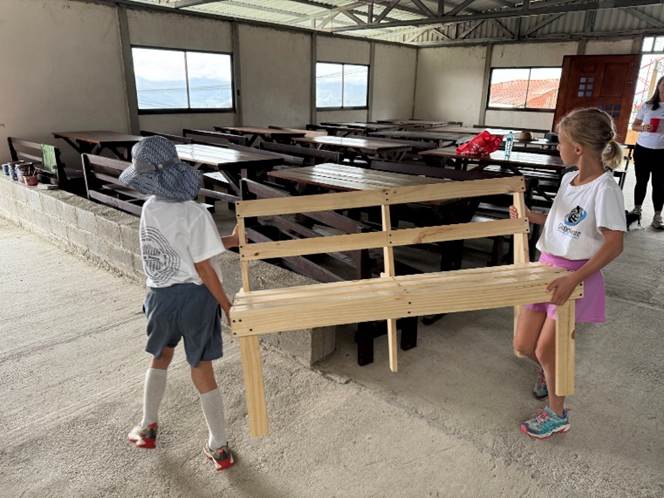
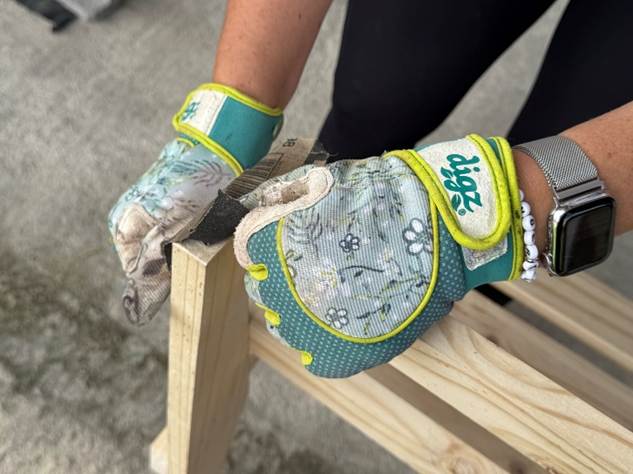
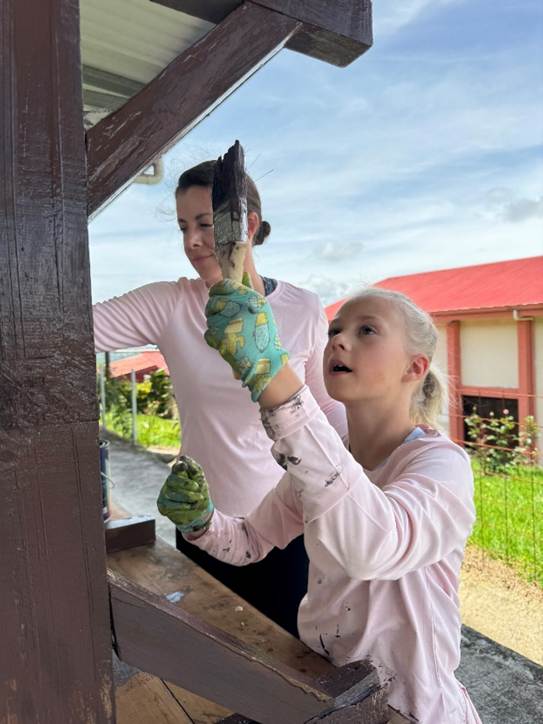
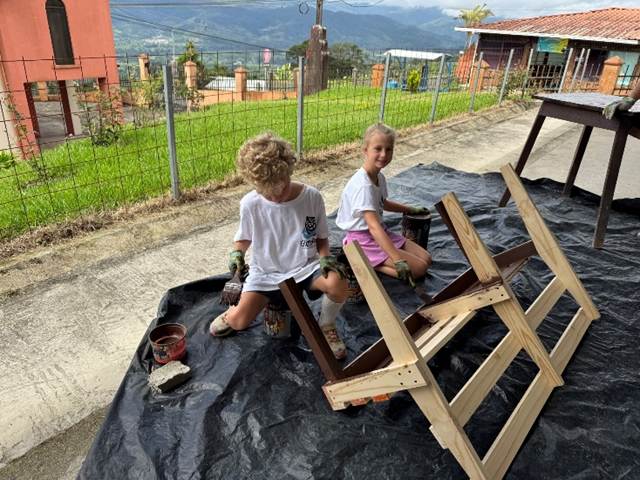
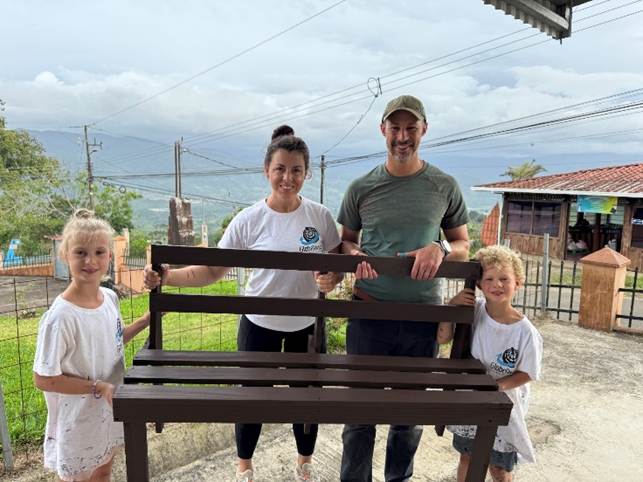
We get right to work. Gustavo has no English but between Federico translating, my broken Spanish, and gestures, we can communicate well enough. It isn’t long before we’ve worked out a rhythm. I saw the lumber. One of the children – usually Jim – starts our screws by tapping them into the wood with a hammer. I drive the screws in with a cordless drill. When a bench is built, we move it outside. Anne sands it. Then Anne and one of the children – usually Farrah – paints it.
I like this. The saw whines loudly over the concrete floor. From the four-inch boards, I make three cuts of 81 centimeters (the backs of the benches). With the three-inch boards, four cuts of 126 centimeters (the seat), two cuts of 122 centimeters (the back), and three cuts of 41 centimeters (to support the seat). With the two-inch boards, four cuts of 17.5 inches (two for each of the front legs).
Gustavo shows me how we will assemble the benches. He places the 81-centimeter planks on their sides and places one 41-centimeter plank over each. We will screw the shorter planks into the longer ones. Gustavo touches the wood with his finger. “Cuatro tornillos,” he says. Four screws. Jim taps four screws into the wood with a hammer and I drive them in with the drill.
Next we turn the 41-centimeter planks upright and we lay a 126-centimeter plank across all three of them. Gustavo holds the wood in place. He points to the end where the longer plank overlaps the shorter one. “Dos tornillos,” he says, pointing. Jim taps two screws into place and I drive them home.
We break for lunch and walk to Gustavo’s house. Federico tells us that Gustavo’s family is very religious. As we enter his home, we see crosses, Bibles, a nativity scene, and other Catholic iconography. His house is simple and functional. A couple bedrooms open off a main space that contains the kitchen and dining area, much like Paco and Luz’s home. Federico tells us that Gustavo built the house. In the backyard Gustavo has built a replica of a nearby church that is smaller than the church that inspired it but still large enough for six people to sit comfortably.
To Jim’s delight we notice that Gustavo and his sons are into model cars. On the walls hang handmade wooden display cases, each with thirty or so cubbies, and in each cubby is a matchbox-sized car. It is only with great restraint and several reminders that Jim keeps his hands off the cars.
Gustavo’s wife has prepared rice, stewed chickpeas, and chicken. We sit down at the table near the kitchen. I can’t tell if it is because of hunger, luck, or genuine respectfulness, but our children eat well and behave themselves.
After lunch we walk back to the community center and build benches until 4:00pm, then return to our house. The children are covered in paint and I wonder how much mineral spirits, time, and fussing it is going to require to get them clean again. Somehow Anne gets them clean in the shower using something she calls a “sugar scrub.” I put on shorts and head out the gate for a run, but at 4,000 feet elevation and in steep terrain, the results are not impressive. I head uphill to the Piedra Azul community then follow an abandoned train route through coffee fields and occasional houses. I walk as much as I run.
For dinner that night we head back up the mountain to La Flor to the home of Paco and Luz’s daughter, Carmen, and their son-in-law, Jose. They live right behind Paco and Luz in a home that Globe Aware built for them. It resembles the other homes we’ve been inside – simple, with a couple bedrooms opening off a larger room that contains the kitchen, dining area, and a sitting area. Carmen has prepared rice, beans, pumpkin cooked in what looks to me like sweet potato casserole, and yucca cakes. Our children eat pretty well, although there are items they taste but don’t return to. Anne and I are thankful that rice and beans, which our kids love, seem to be served at every meal.
Jose and Carmen have a ten-year-old daughter, Jadeyana (jah-dee-ahn-uh) and our kids are thrilled to see someone near their age. They ask to see her room and she takes them to a small room with a pink bedspread, a pink chair, and pink curtains. A handmade dollhouse – a gift from her Uncle Gustavo – takes up much of the floor space.
Farrah points to a stack of cards lying next to the dollhouse. “Uno!” she shouts.
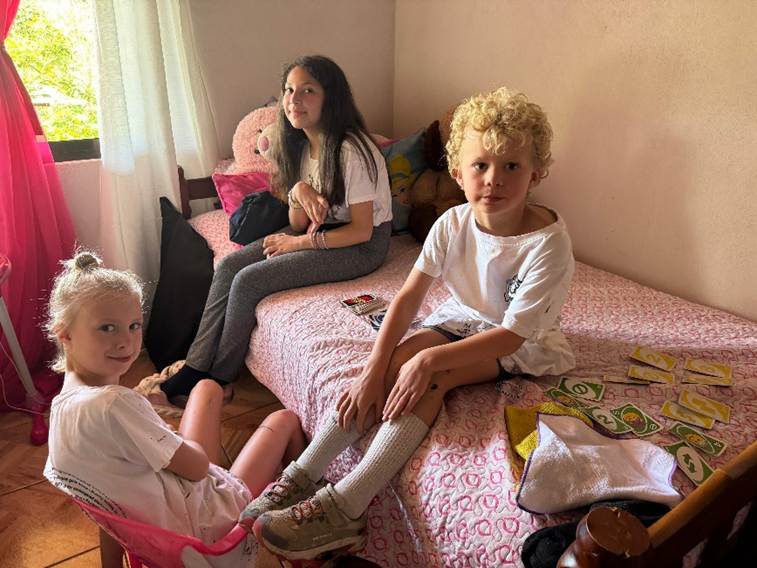
The kids play Uno while the adults retire to the sitting area. Farrah and Jim will later explain that they were able to play despite the language barrier because Jadeyana could say the colors in English, and the Butler kids could say the colors in Spanish. We adults rely heavily on Federico for translation.
I ask whether Jose and Carmen think their children will stay in the area. They’re not sure, they respond through Federico. They think Jadeyana is likely to stay, but their high-school aged son is really into his studies and he may move elsewhere. I ask where, but they are not sure. In English, Federico tells Anne and me that most people around here don’t think much beyond high school. There doesn’t seem to be much point, in their view. He tells us that it is really difficult for people to move from one lifestyle to another.
Dark has fallen and it is time to go home. Over their protests, we extract Farrah and Jim from Jadeyana’s room and get them into the van.
I’ve always taken for granted that Farrah and Jim could make their own lives – that they could live like Anne and I do, or not; that they could remain near their parents, or not. Now I wonder whether those assumptions are uniquely American or uniquely privileged, or both.
On the ride home Federico tries to explain. He once took Paco and Luz to some famous hot springs near the town of Orosi where he regularly takes volunteers. The hot springs are about forty minutes away from La Flor by car. Paco and Luz have lived in this area their entire lives. They had never been to the hot springs. Federico once took one of Paco and Luz’s children to the national forest that is just a few minutes past the hot springs. They had never seen it.
Lives around here are very, very local, Federico says. Travel takes money and time. Money is in short supply, and if you’re a farmer, the farm won’t tend itself.
Federico tells a story. He used to take volunteers to a community that was divided by a creek. During one rainy season the creek washed out the bridge, so the local people got organized and found a huge log in a nearby forest. They sawed it in half lengthwise, so it was flat on top and round on the bottom, and laid the log across the creekbed. For years, that was the bridge. Then during one volunteer trip when Federico’s attention was elsewhere, a group of fifteen young volunteers stood on the bridge and started jouncing it. It snapped and crashed into the creek. Nobody was hurt but the bridge was finished.
“‘I was trying to explain to them, this is bad,” Federico recalls. “But they did not understand.” The volunteers asked why the locals couldn’t just get another bridge or walk through the small creekbed. Federico told them that bridges are expensive, huge logs are not common, and saws that can cut logs in that way are rare. As to jumping across the creek, Federico explained that the area was muddy and locals have to take care of their shoes. “Shoes are expensive and hard to clean,” he said. If you ruin a pair, you may not be able to replace them.
“Obstacles that seem small to volunteers can be very big to people who do not have much.”
May 28, 2025
Before the kids are up Anne and I sip coffee on the porch. We watch a cloud bank drift down the valley like foam on a slow-moving river. The clouds obscure most of the mountains on the far side of the valley and we see only patches of the dark green massif beyond.
We have come to love these slow mornings.
A flock of bright green parakeets flies by, moving in the same direction as the clouds. Beautiful birds with raw, screechy calls. It sounds like a flock of rusty door hinges in need of WD-40. Speaking of noisy – the children have just gotten up. Time to start breakfast.
At 8:30, we are off to build benches. Same rhythm as yesterday. As I run the saw, Gustavo feeds lumber to me. We work wordlessly. Gustavo moves deliberately, deftly. A natural craftsman. He expects high-quality workmanship. So do I. I feel a kinship with him. The children are outside painting and the only sounds inside the community center are the whine of the saw and the clack of lumber as hits the floor. Sawdust piles up.
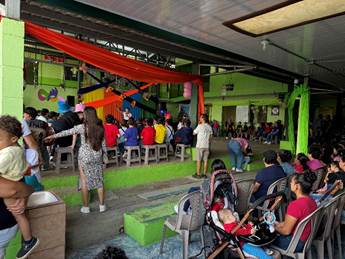
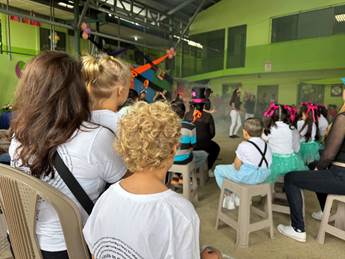
At noon we break for lunch in the home of a local family, and after that our kids are in for a show – the school in La Flor is having an arts festival. Federico takes us to the school, which is a few doors down from the community center and across the street from Paco and Luz’s house. We sit behind rows of local kids and adults in an open-air gym. Each class will perform a dance routine, sometimes to Spanish music and sometimes to English. We see a kindergarten performance, a performance by young teens, and some in between. The scene vibrates with color and noise – bright green walls, red and yellow festoons, upbeat music, clapping hands.
We see Jadeyana sitting with her classmates. My kids are eager to watch her performance, but we don’t know when her class will go and we have to get back to work. Farrah and Jim settle for a quick hello. We walk back up the street to the community center. Federico looks relieved to escape the noise. I empathize.
Today we stop work a little after 3:00pm. Federico has a coffee shop he wants us to see. I am reluctant to quit so early – we came hear to work, didn’t we? – but I remind myself, before Anne has to, that eight- and six-year-olds don’t have the same attention spans as adults. Gustavo and I finish the bench that we’re working on, then I brush the sawdust from my pants. We load into the van.
The coffee shop that Federico had in mind is wonderful. Our polished wooden table overlooks a lush Costa Rican valley. The kids drink local juices and a sweet cornbread-like pancake that Federico ordered. Anne and I have beers.
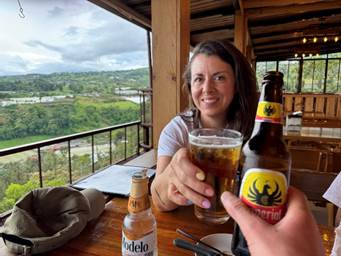
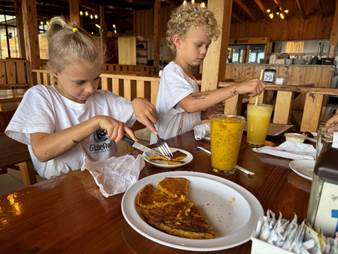
I try to talk Federico into having a beer with us but he is on the job and declines to be corrupted. Instead he tells us about the valley. He shows us where water is impounded before being distributed and where farmers are growing produce for WalMart.
We ask him about Globe Aware. A woman from Dallas created the company around 2000. Federico joined around 2005. At the time he was freshly back from Indonesia, where he had spent six months surfing. Now back in his home country, he needed a job. At that time, Globe Aware was running a volunteer program on the Caribbean coast of Costa Rica and the person running that operation was about to move to the United States. Federico stepped into his role. After a few years, Federico moved the program to the Orosi Valley in the central part of the country. He found the house out of which the program now operates and built the local relationships on which the program is now based.
Anne starts asking about other Globe Aware programs and whether Federico would travel to lead them. What does he think of the Guatemala program? Would he be willing to join us and the local coordinator there during a future summer? What does he think about Globe Aware’s program in Peru? Would he travel there?
I gaze out over the valley and drink from my beer. I’m just glad Anne is into this. The beer is cold and bubbly, but what really makes it great is the sawdust that preceded it.
May 29, 2025
Today we will take a break from building benches and explore the natural beauty of the area. That’s about the only kind of beauty to find around here because there are no metropolitan centers in the Orosi Valley. Which suits me just fine.
We begin with hiking. Federico takes us down into the valley and to a hotel beside the lake in the center of the valley. To my passing eye the accommodations look as luxurious as you might expect to find – a big hotel, cabins for rent, and a huge veranda set for breakfast. An older couple eating breakfast outside waves at us as we traipse toward the lake.
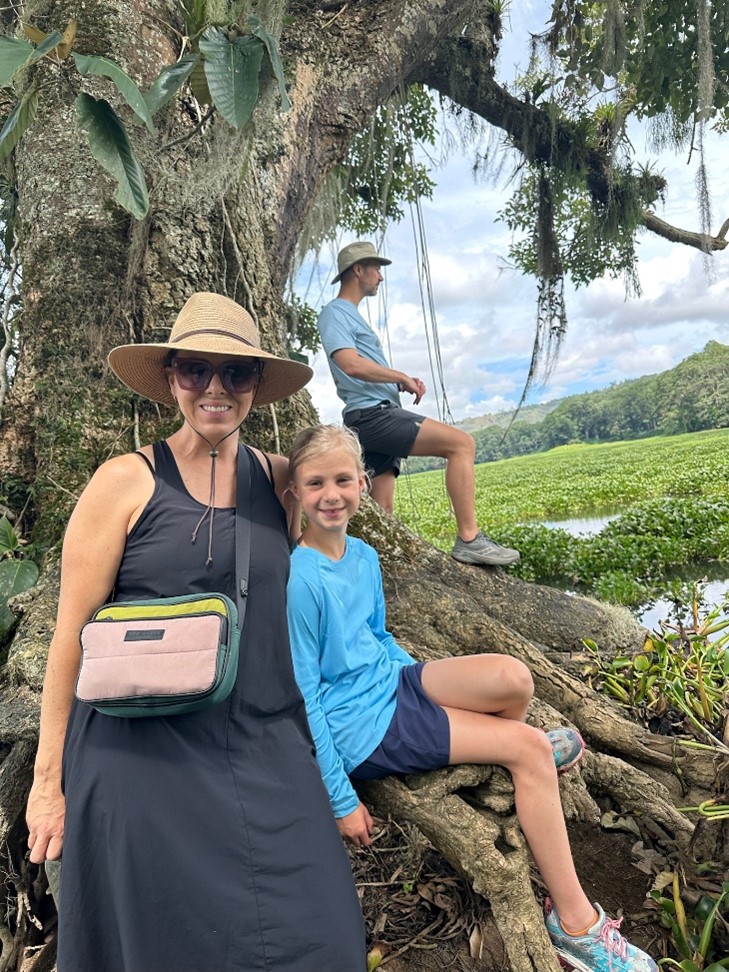
A short hike through jungle takes us out onto a small peninsula anchored by a huge tree. Burly, gnarled roots hold the tip of the peninsula in place and reach into Lake Cachi on three sides. A narrow path through high grass leads us to the tree. We sit on the roots.
Most of the lake is covered by water lilies. The surprising thing is – they move! The wind blows clumps of water lilies to and fro across the lake, stacking them up against the downwind shore like an airy game of Tetris. We watch for awhile then pose for pictures.
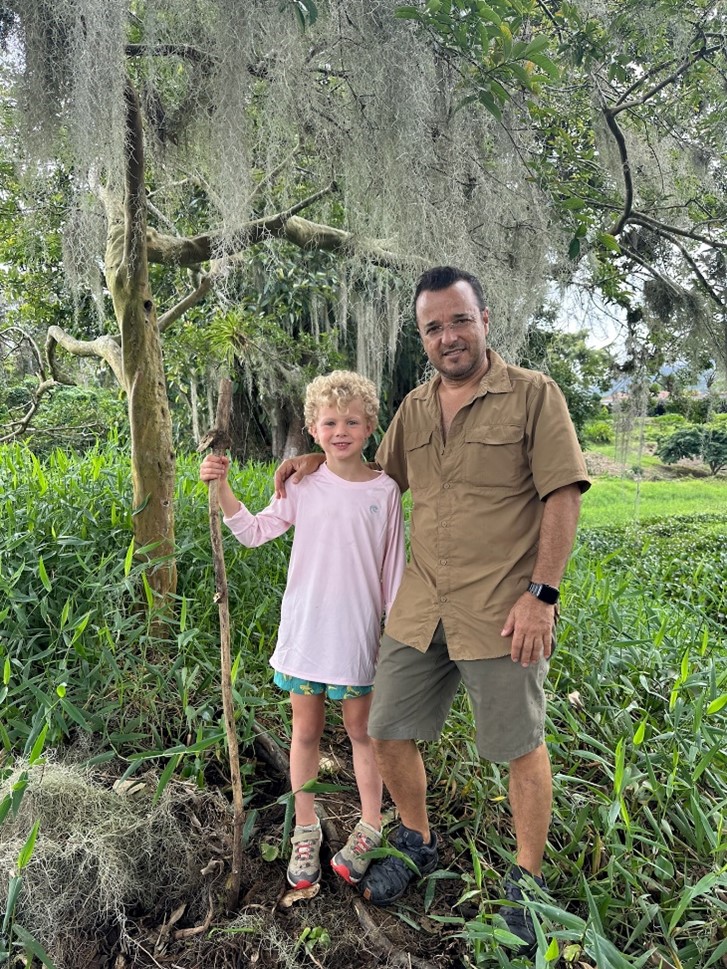
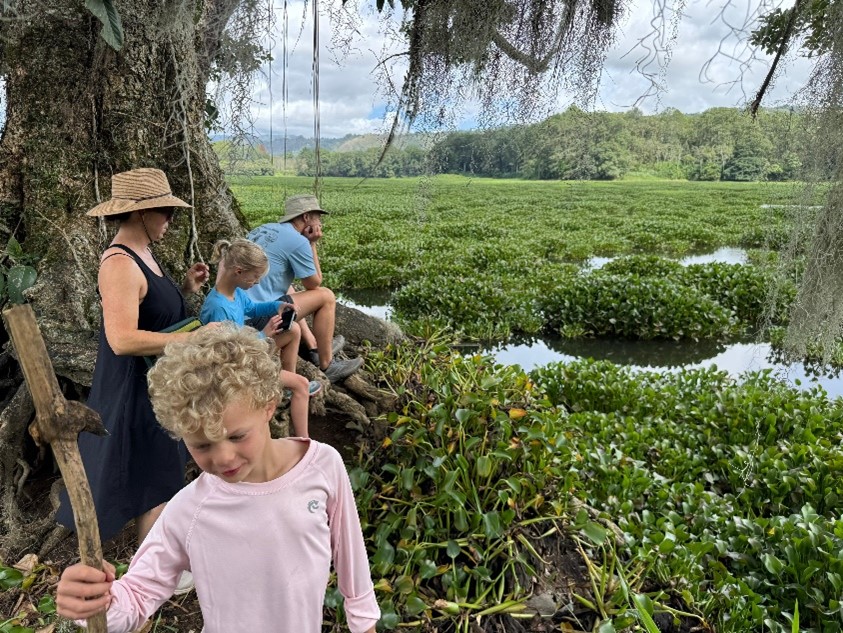
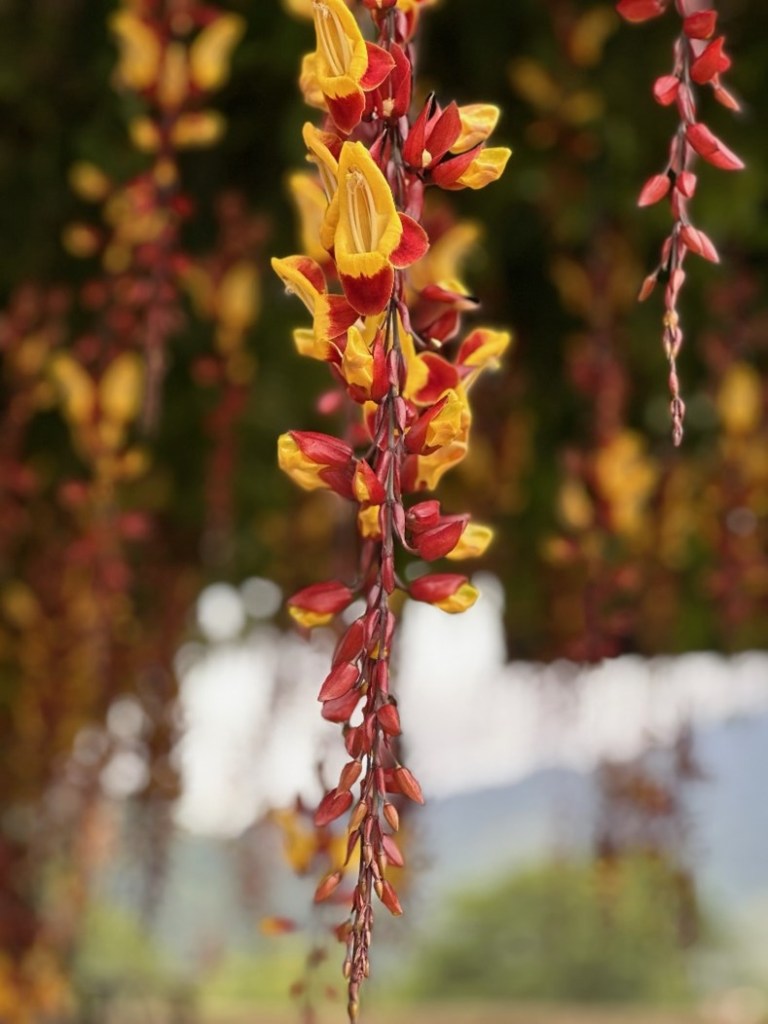
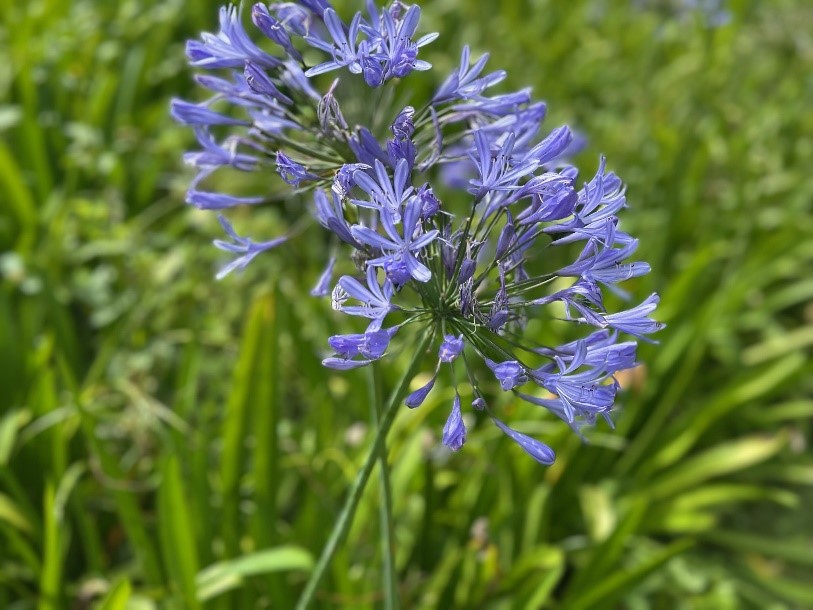
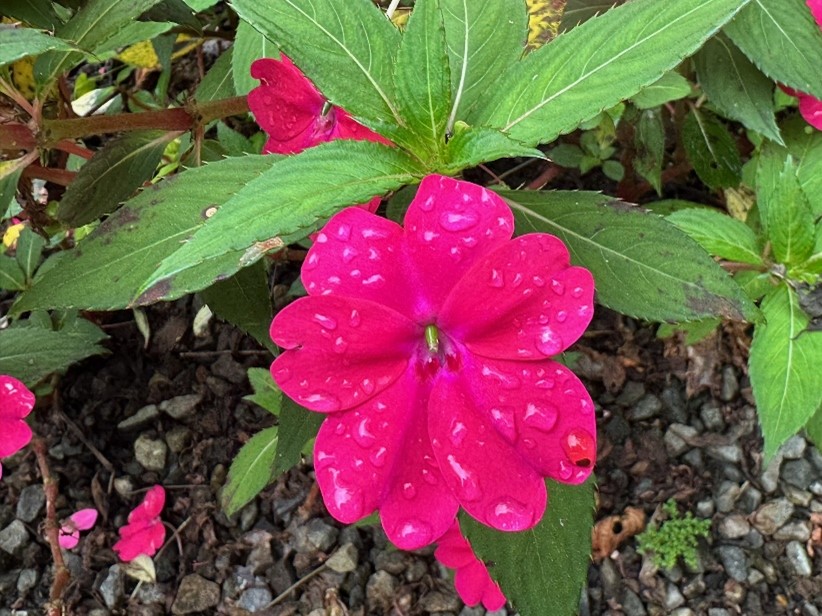
We drive past the town of Orosi and into the mountains on the far side of the valley, and on foot we follow a trail into the jungle. Here we find the cardiovascular workout I’ve been hoping for. The hike is just over 1.5 miles but it is steep. We head up a mountainside, following switchback after switchback through dense foliage. Farrah and Jim bound up the trail ahead of us. We take breaks for pictures and rest. Anne began a spree of still-life floral photography this morning and she continues with that. The rain forest is a good place for it. We climb until the trail reaches its zenith. My hat band is soaked with sweat. There is no reason that I can see for the trail to stop where it does – no waterfall, vista, or landmark – but after our steep climb, we begin an equally steep descent. It is a great trail.
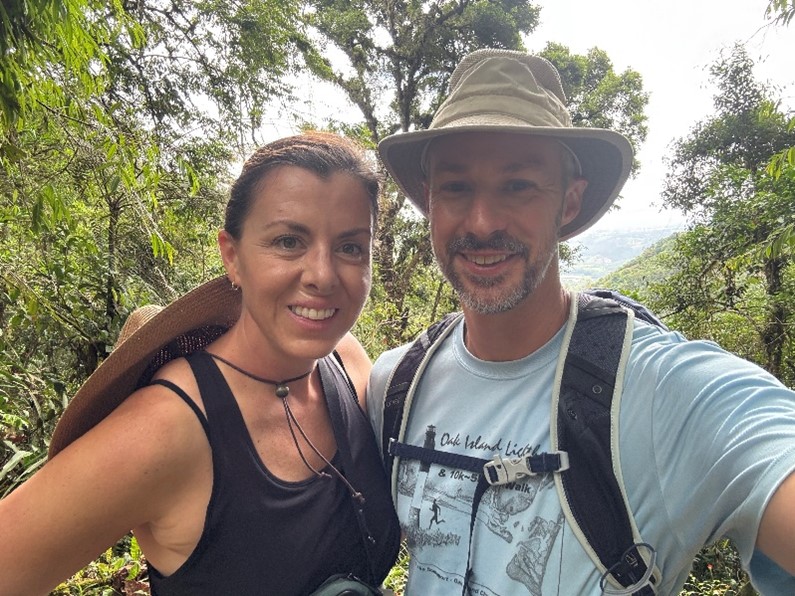
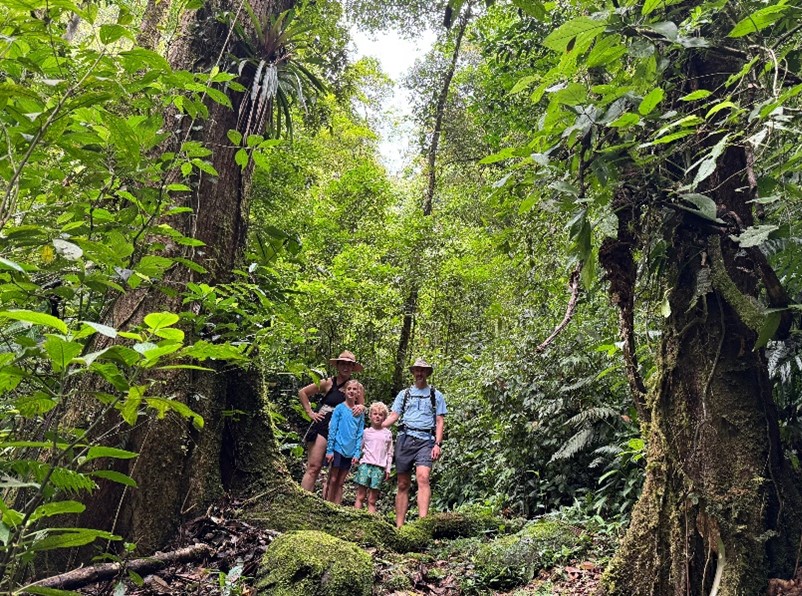
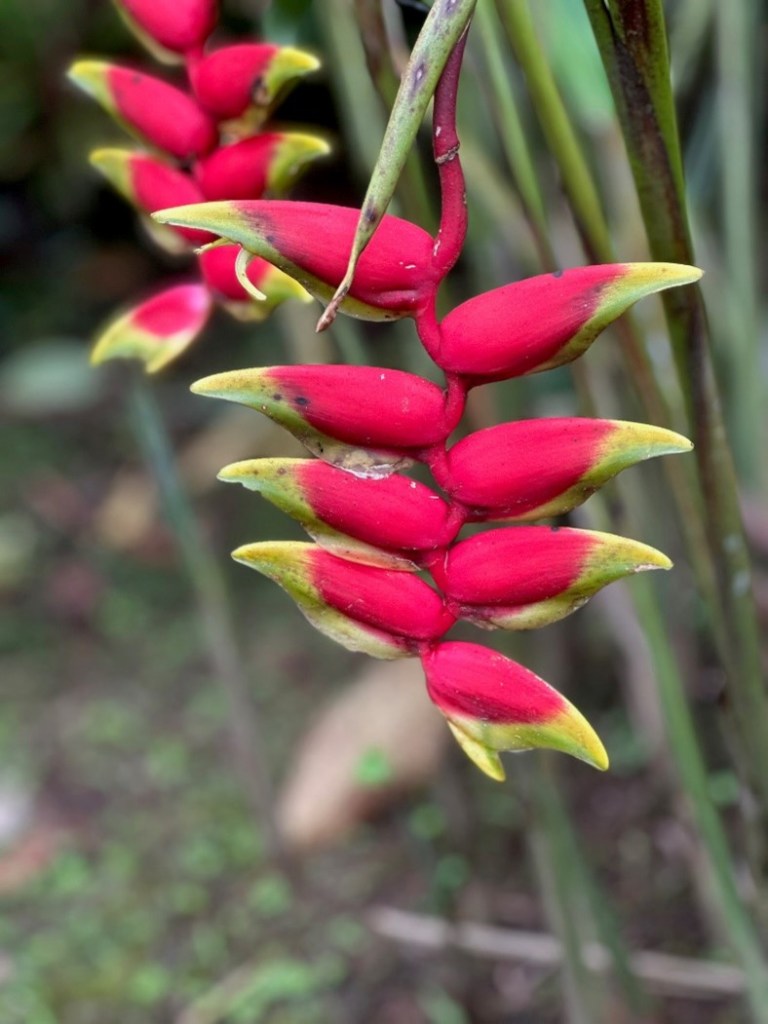
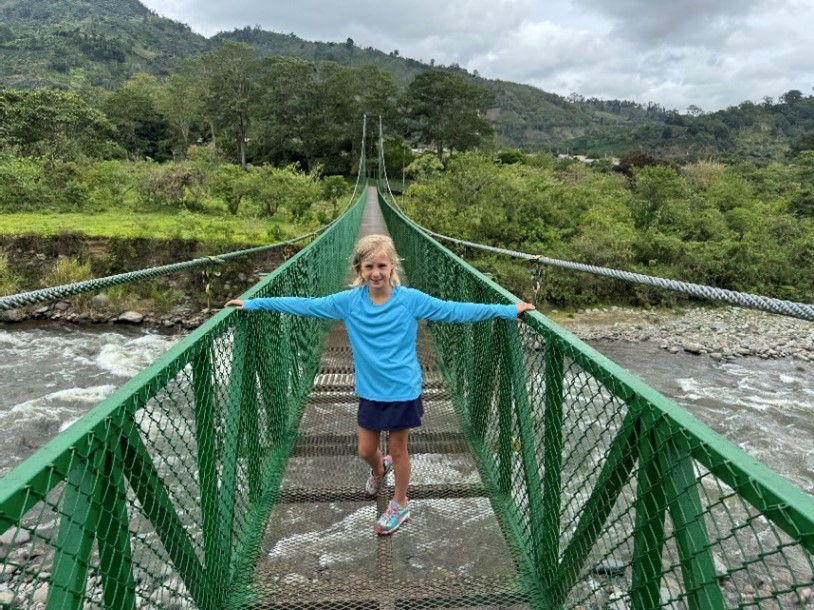
After the hike, we walk across a long footbridge and into Orosi for lunch. In the center of town gray-headed men play soccer on the same field where I played tag with Farrah and Jim three days earlier. They’re good. We eat lunch on a nearby rooftop patio and I am entertained to order a “casado,” a Costa Rican dish so named because it is what a married man might expect his wife to cook – rice and beans, vegetables, plantains, and a small serving of meat.
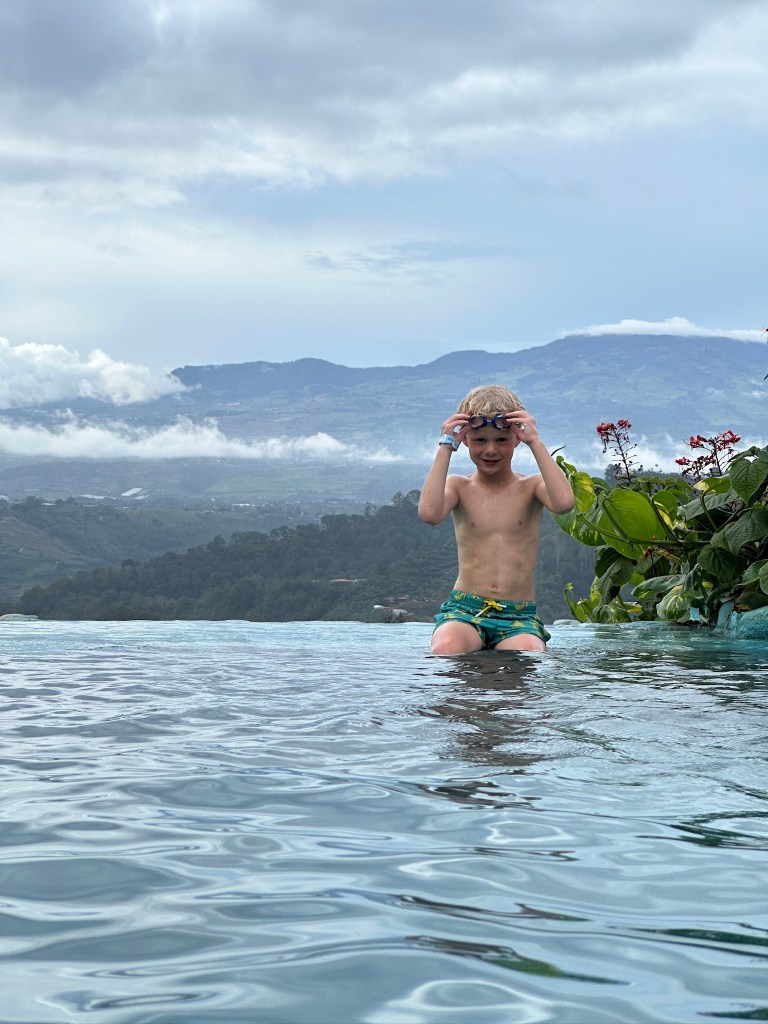
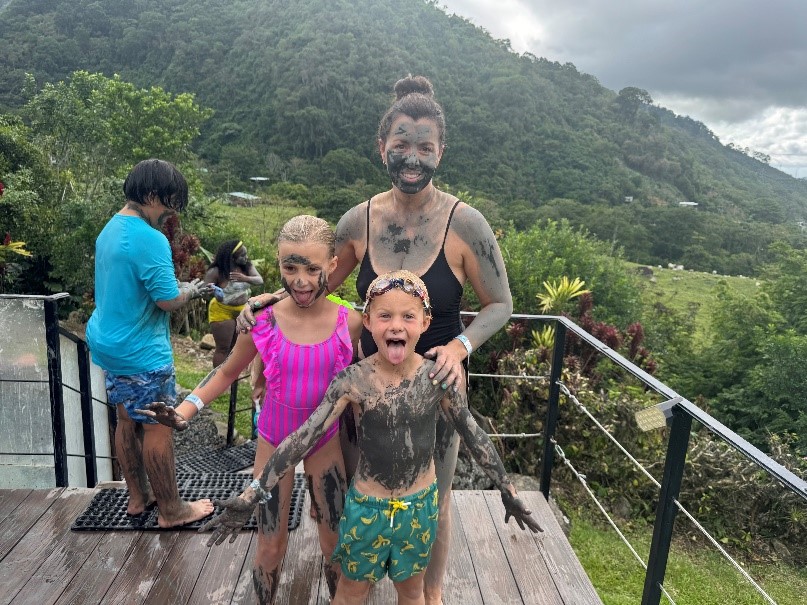
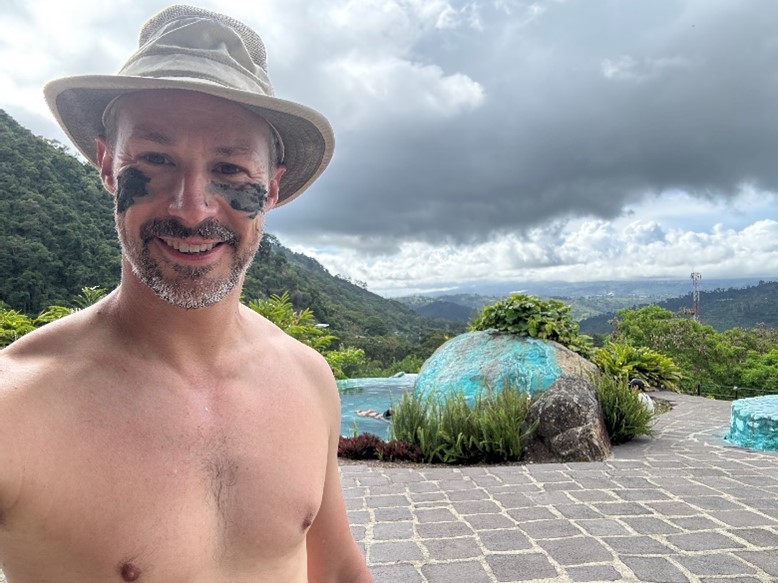
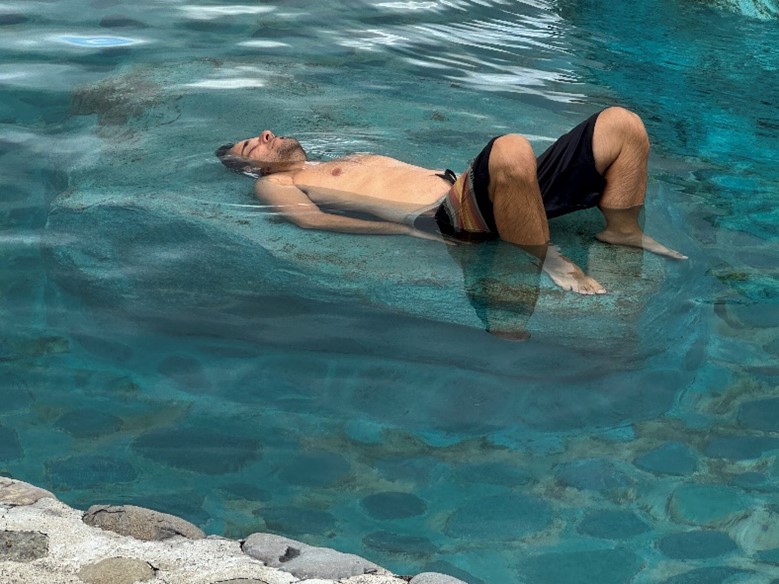
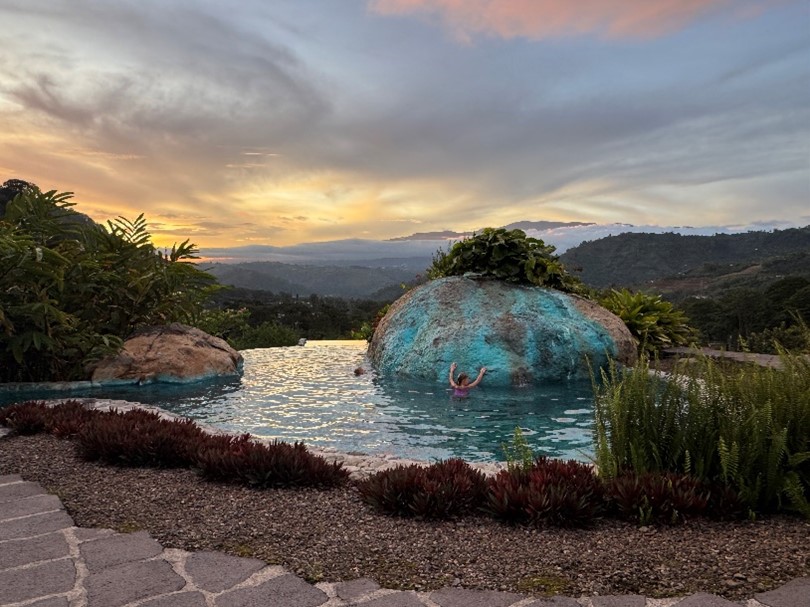
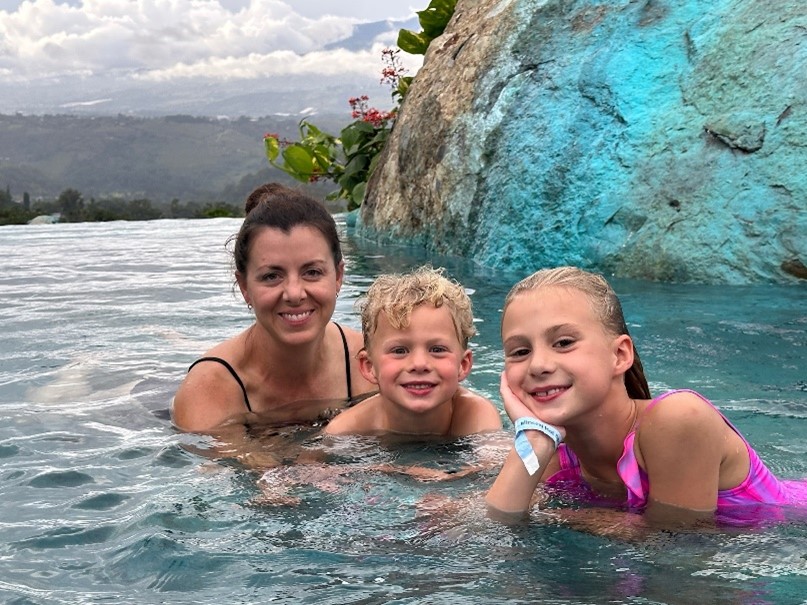
After lunch we are in for a treat – the hot springs. We’re told that in years gone by, these hot springs existed in a natural state, like pools in a river. Now the area is commercialized, but we sure enjoy it. The hot water is piped into six manmade pools, each with a set temperature between 95-102°F. The pools overlook the Orosi Valley, and a covered patio where waiters serve food and drinks overlooks the pools. We splash in the pools, smear our bodies with mud, eat the food, drink the drinks, and otherwise behave like happy American tourists. We stay until dark.
The ride home is quiet. I ride up front with Federico. He works the diesel engine and short-throw manual transmission with precision. We pass out of Orosi and onto the country road. Our van is the largest vehicle on these roads but I can’t recall anyone ever passing us. Federico downshifts and propels us past slower vehicles, sometimes two at a time, with an indifference to road markings and curvature that would excite authorities in my home country. I enjoy it.
I ask Federico about his life here. I’ve come to know him well enough to realize that he doesn’t fit naturally into this social fabric, and I think he knows that I see that.
“The city overwhelms me,” he says. Our headlights illuminate the dense foliage on both sides of the road.
“Would you ever leave the Orosi Valley?” I ask.
He pauses. “It would take a very pretty flower,” he says.
May 30, 2025
This will be our last full day in Costa Rica, so we do our best to savor the slow morning. We’re on the pleasantly warm porch sipping coffee not long after the sun has come up. The birds call, the clouds drift. When the kids are hungry I cook eggs and Federico slices fruit. I hear Anne tell Federico that she hasn’t prepared a meal in six days and feels good about it. She does ask Federico to show her how to properly slice a mango.
We meet Gustavo at the community center for our day’s work. He and I resume our wordless rhythm of sawing lumber and assembling benches. We are more efficient now. Farrah and Jim are more focused today after yesterday’s day off – their attention had begun to wane the day before, but I guess yesterday was restorative. Today they measure boards with me, paint benches with Anne, and repaint a door with Federico.
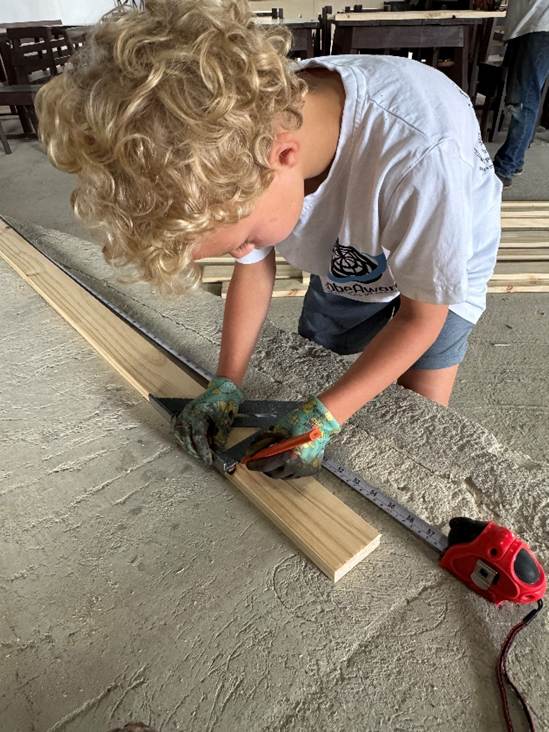
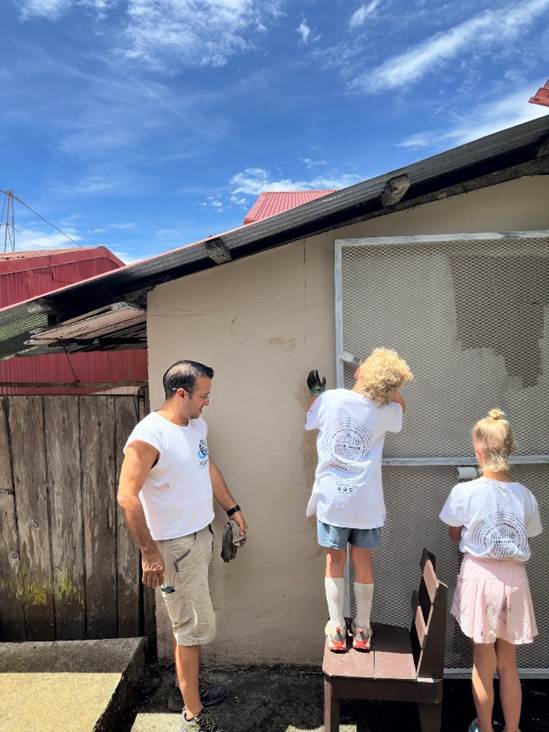
After each bench is built, we subject it to a rigorous Wiggle Test.
For lunch we return to Jose and Carmen’s house, where the kids have an opportunity to play another hand of Uno with Jadeyana. Playing with her has been their favorite part of the trip. I should have predicted that, but I didn’t – I guess in my self-absorption I forgot how important it is for children to interact with children. Farrah and Jim interact well with most adults but they identify the most with other kids. Meeting other kids is probably the best way for them to internalize what I hope they’re learning.
We return to the community center and work until 3:00, when Federico has another coffee shop he wants to show us. We assemble, sand, and paint the last of the Butler Benches. Gustavo’s wife joins us at the community center to bring fruit and snacks and to thank us for our work. We thank Gustavo for guiding us, sweep the sawdust from the floor, and load the tools into the van. I shake hands with Gustavo, exchange cheek-kisses with his wife, and we leave the community center for the last time.
We leave La Flor and drive along a ridgeline, passing through the small towns of Cervantes and San Isidro. The drive is nice but my thoughts are with the saws, drills, and paintbrushes. I wish we were still working, although I know that we’ve worked about as much as eight- and six-year-olds can be expected to and that producing one or two more wooden benches would not make any great difference in the world. Federico tells us that we made more benches than most volunteers do, and I don’t believe him until he explains that many of the volunteers he works with have never sawed a board or swung a hammer.
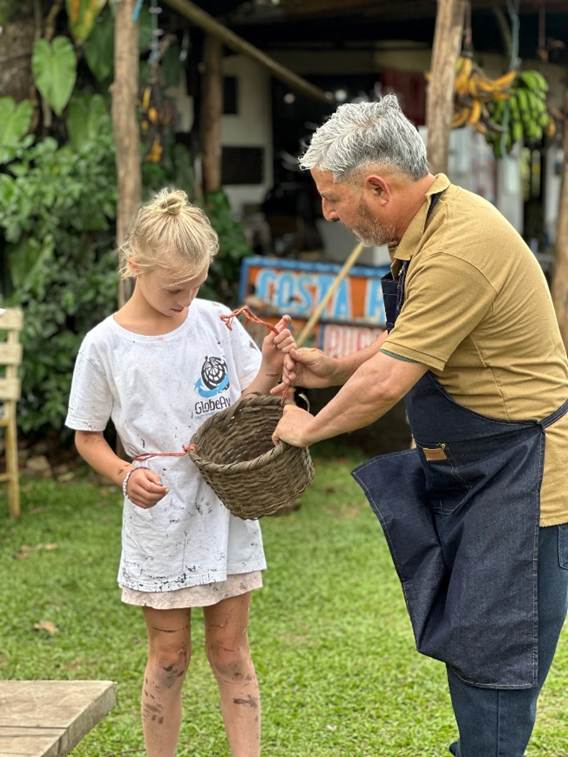
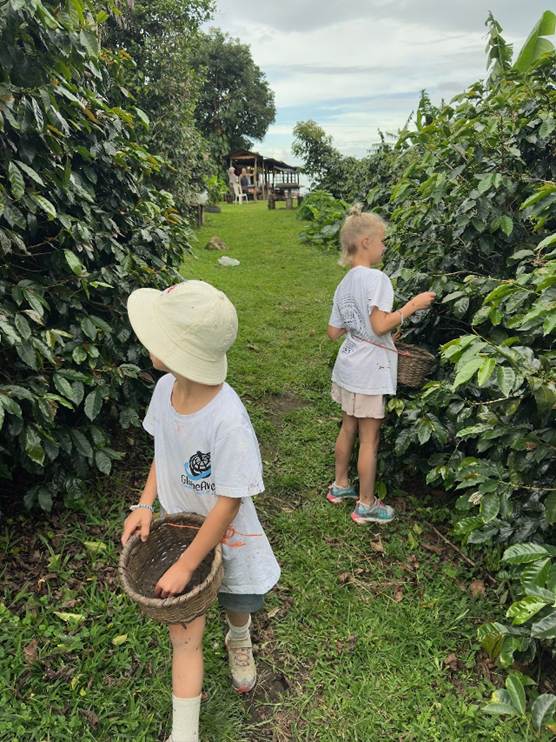
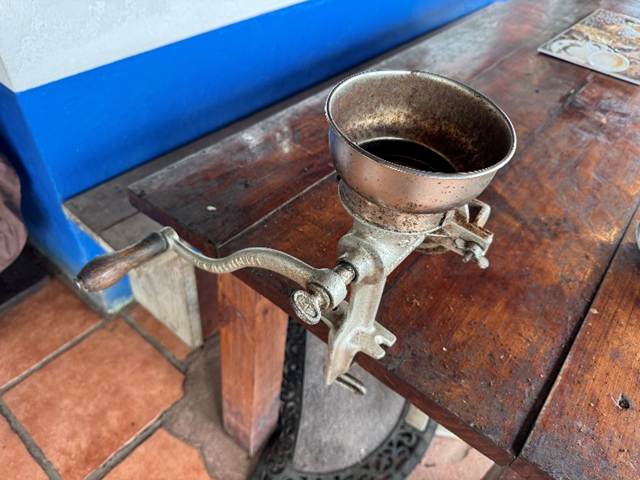
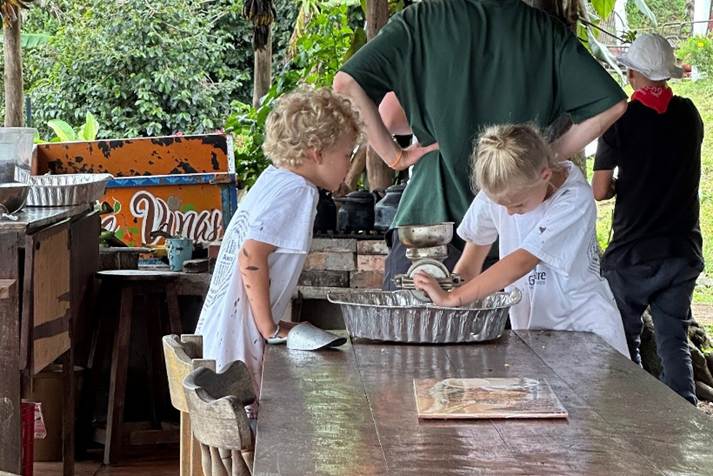
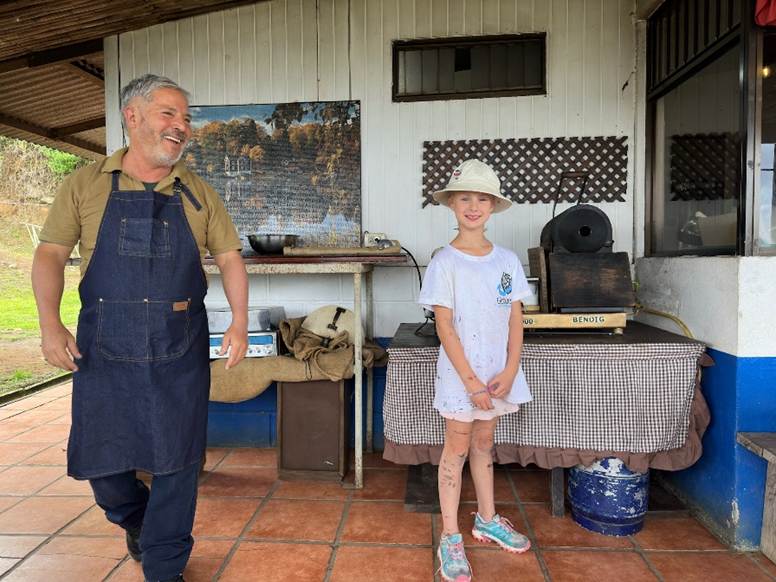
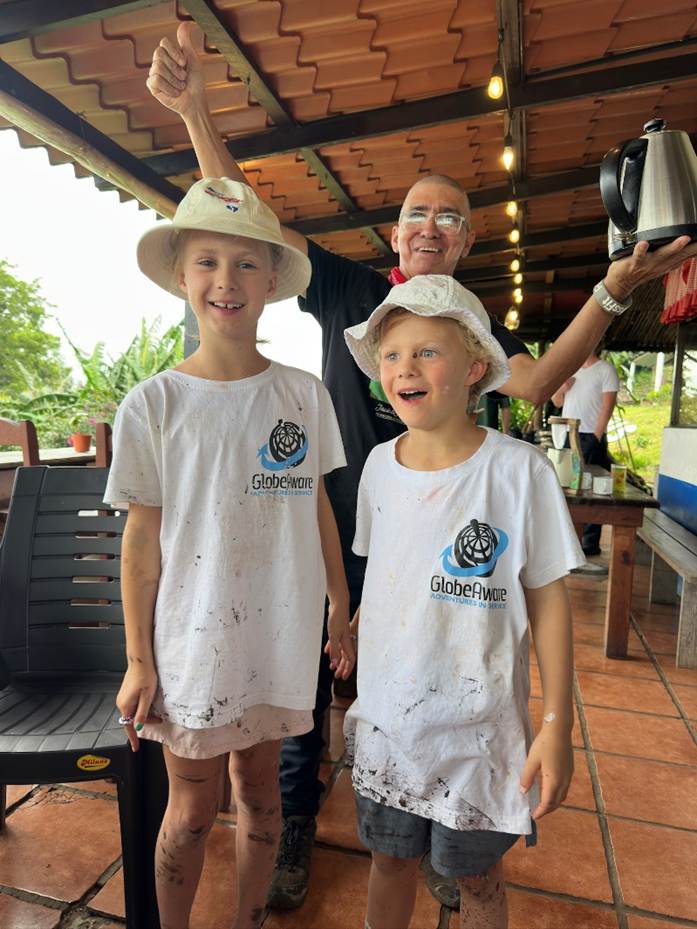
My feelings aside, our destination, Café Viñas, is cool. The proprietor has turned his home into a coffee shop featuring beans-to-cup production. He ties baskets around our kids’ waists and they pick coffee beans. Jim helps separate the husks from the beans and we watch as beans are roasted. Farrah and Jim crank the handle on a coffee grinder, turning roasted beans into grounds. A waiter pours hot water over the grounds as we sit on the patio overlooking the green valley of the Rio Reventazon. The coffee is wonderful, so much the better because we played some role in its production.
My pants are still covered with sawdust and as we drink coffee I think about what we have accomplished here. Of course building benches with an eight- and six-year old is not the most efficient way to improve the world. If our only goal were to fill the community center with benches, I’m sure Gustavo and Federico could have built more benches in less time if they had done the work themselves instead of guiding our family. Or more to the point, if we had donated the cost of our airfare and trip to this community instead of making the trip ourselves, Gustavo could have used that money to buy a several roomfuls of benches.
We could tell that the people who live in La Flor are not destitute. Their houses are simple and their travel is limited, but my impression is that the people we’ve met have their basic needs met and have had access to education. They certainly have needs that we don’t back home, but I remember my previous Globe Aware trip to India in which my friend Naveen Ramachandrappa and I worked in a Jaipur slum. The children we worked with on that trip lived in poverty, had limited access to fresh water, longed for candles so they could see at night, and had little access to education. We did not see that level of need in La Flor.
So why are we here? I think there are a couple reasons.
But before we can assess the reasons, we have to decide what we’re comparing this trip to. In terms of making a real difference for people who need it, nothing compares to effective altruism – that is, making money using your unique skills (in my case, practicing law) and donating that money to enable the work of professional humanitarians who can work more effectively and efficiently than you can. In recent years, Naveen and I started an organization called Smart Giving that is devoted to that kind of thoughtful philanthropy. If our only goal were improving the world for people who need it, then Anne and I should have stayed home and donated our travel money in accordance with those principles.
But those aren’t our only goals. Anne and I also wanted to expose our children to people who live differently, teach our children about service, and do something fun. A fairer comparison for this trip is the trip that we might have taken if we had not come here. Maybe a trip to a family resort at the beach or in the mountains. That is the real opportunity cost.
So why did we come to the Orosi Valley? First, Globe Aware has connected us with the local community in a way we would not have connected if we had stayed at a resort. By eating lunch and dinner in the homes of local families, working alongside Gustavo, and hanging out with Federico, our family has interacted with another culture in a way we would not have at most resorts.
Second, I hope that this trip has taught our children (and us) something about service. During the time we spent inside the community center, our kids worked – sometimes voluntarily, and sometimes because we made them, but they used their own hands to help other people. And although the folks we’re helping are not destitute, they are far less privileged than the people to whom Farrah and Jim are regularly exposed back home.
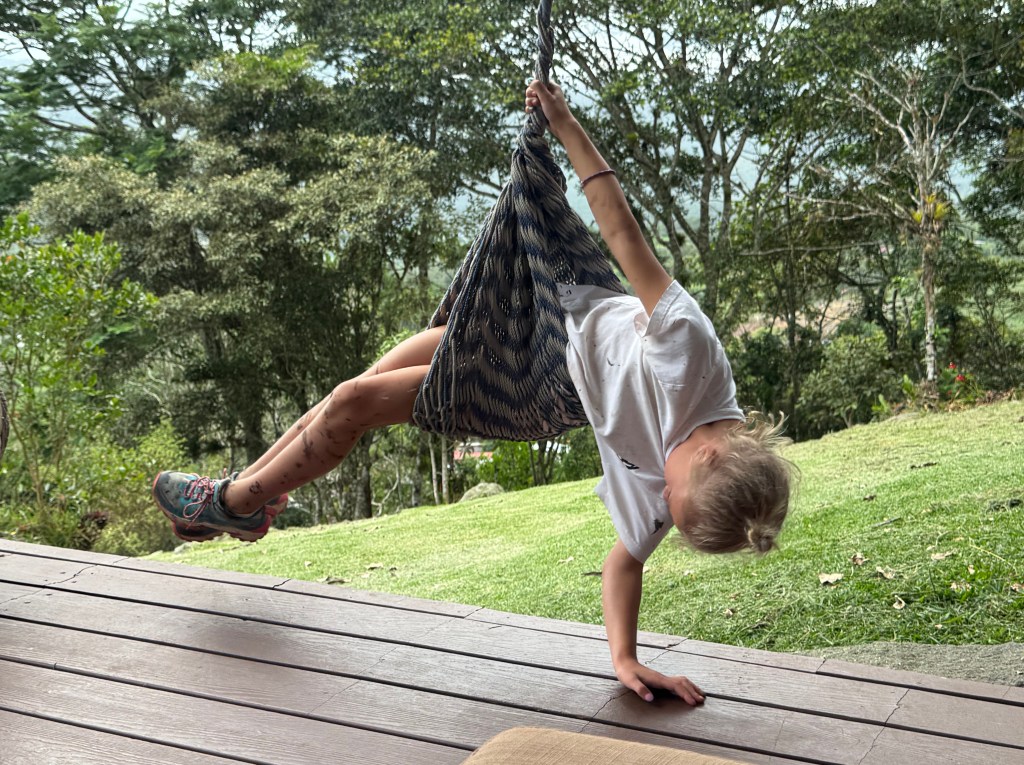
I take a sip of coffee and watch colorful birds fly across the valley. This is a decision I would make again.
May 31, 2025
Today we go home.
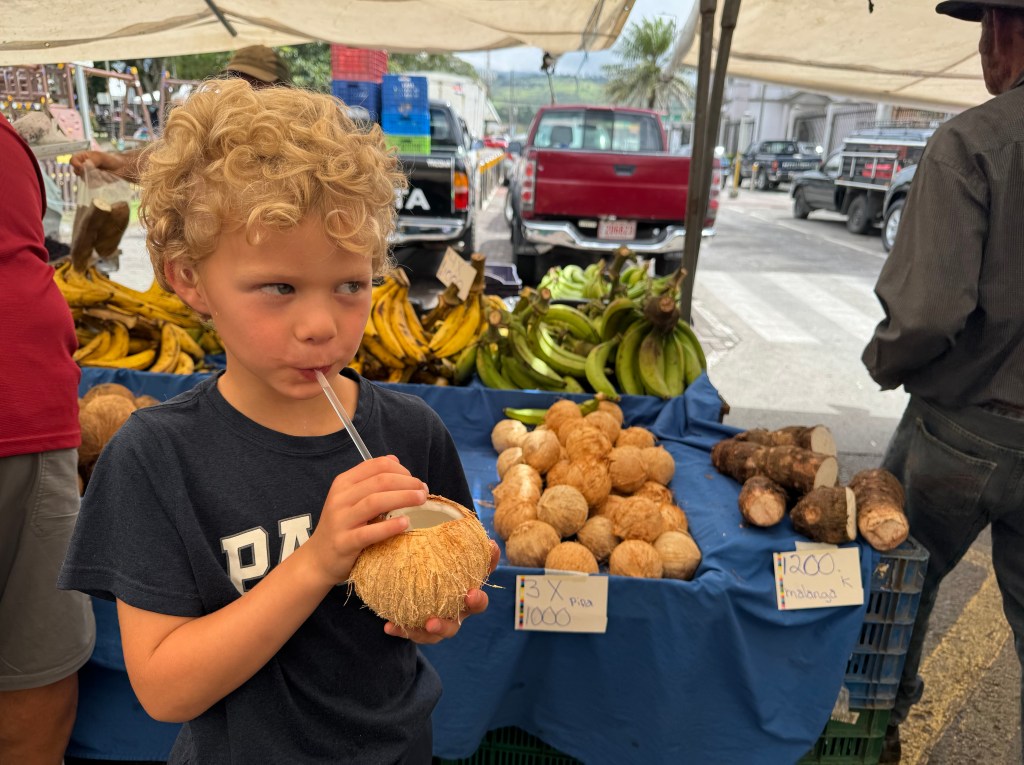
We leave the Globe Aware house early enough to stop by a farmers’ market on the way to the airport. Federico identifies the fruits and vegetables we’ve never seen. He’s trying to help us squeeze the last little bit of Costa Rica out of our trip, and it’s fun but like most departure-day outings, the adventure is overshadowed by timetables and travel concerns. Farrah and Jim did well trying new foods though – they tried and liked coconut juice and a new kind of banana. Jim and I tasted grasshoppers but were underwhelmed.
We arrive at the airport and say goodbye to Federico, who we will miss. From there the travel is routine. Busy airports, crowded spaces, long flight, traffic. When we get home there is no time to cook dinner so we sit around the kitchen counter eating a meal delivered by Uber.
Without being prompted, Farrah and Jim start contrasting life in Costa Rica with their lives in Atlanta. And their observations are . . . pretty good!
“They don’t have as much,” Farrah says. “I’m not saying anything bad,” she adds, “but their houses are not as fancy.”
Jim observes that most of the houses only had one bathroom for the whole family. They talk about Jadeyana’s room, and how it was smaller than most of the kids’ rooms they’ve encountered in Atlanta, and how Jadeyana made good use of the space but didn’t have as many toys. Farrah says that the Costa Ricans don’t waste as much as Americans do. Jim comments on the different quality of the roads.
I smile and keep quiet. It is the kind of conversation I hoped they’d have.
I’m not saying that our children’s outlook on life was so fundamentally altered by their week in Costa Rica that they will henceforth express only gratitude and they will never again ask for a superfluous toy. But they encountered something new, they worked to help others, and they learned something. They are good kids and we had a good time.
Pura vida! I hope we do it again.
 Jeb Butler